There’s a moment most people know but rarely name. You’ve been at your desk or behind the wheel for a few hours — focused, productive, holding it all together — and then you stand up. And your body takes a second to agree with the idea. Your hips pull tight. Your knees make a sound that wasn’t there two years ago. Your lower back offers a quiet protest before slowly releasing. You didn’t fall. You didn’t overdo it. You just sat. And somehow, that was enough.
This isn’t dramatic pain. It doesn’t stop you from functioning. But it does change how you move through the second half of your day — a little more careful, a little more aware, a little slower to trust yourself on the stairs. That creeping afternoon stiffness is something millions of people live inside of without ever quite questioning it. They assume it’s age. They assume it’s normal. They assume it will just be part of how things go from here.
But stiffness like this has a story. And when you understand what’s actually happening inside your joints during a long, still afternoon, you realize it isn’t inevitable at all.
The Quiet Biology of a Long, Still Afternoon
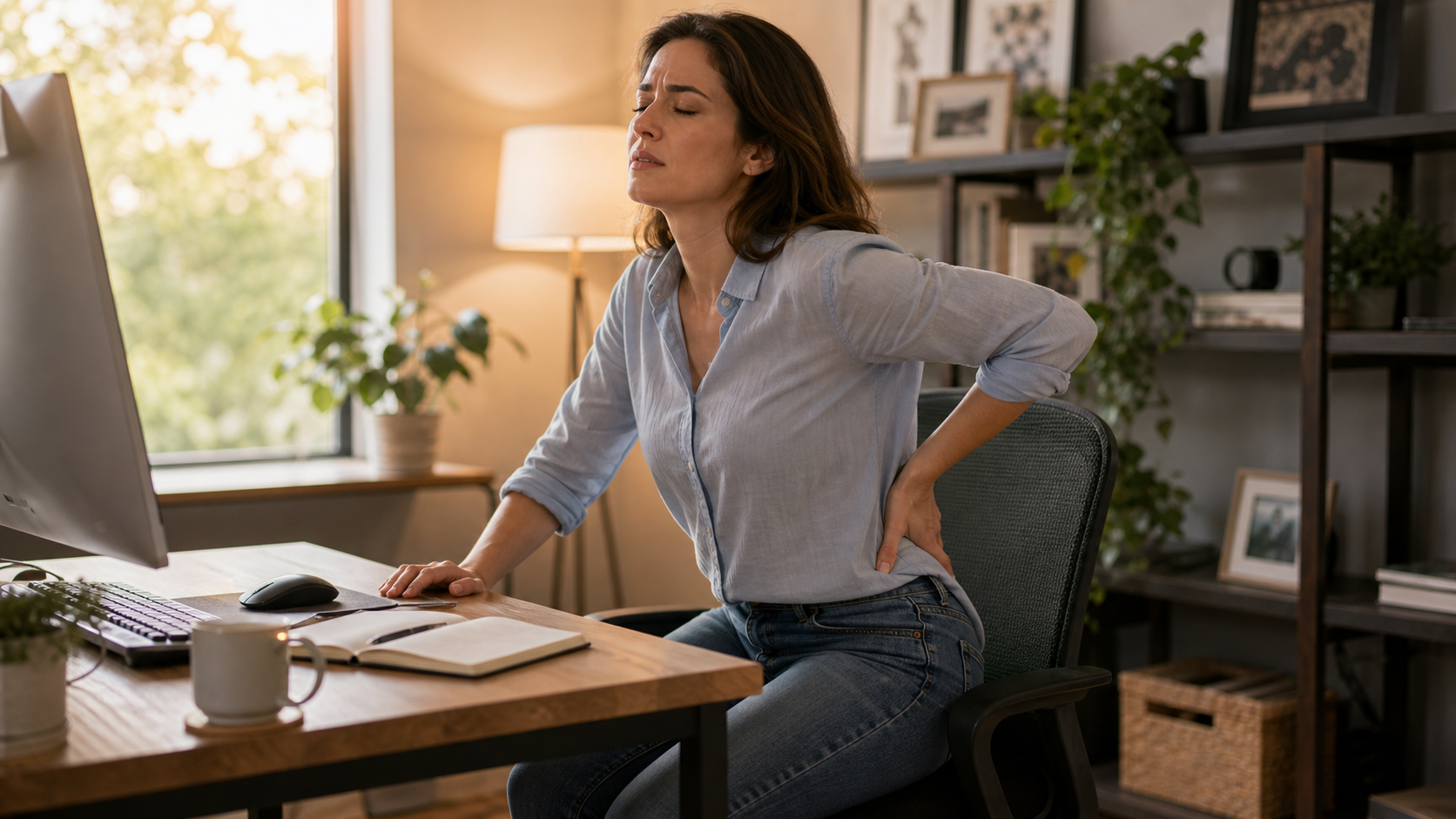
Your joints are designed to move. That sounds obvious, but it matters — because movement is actually how your joints feed themselves. The cartilage inside your knees, hips, and lower back doesn’t have its own blood supply. Instead, it absorbs the fluid it needs through compression and release — through the gentle pumping action of walking, shifting, bending. When you stay still for two or three hours, that exchange slows almost completely.
What fills the space between your bones is called synovial fluid. Think of it less like oil and more like a living cushion — rich, thick, and constantly being produced and absorbed. When you move, it circulates. When you don’t, it stagnates. And like any fluid system that stops moving, things thicken up. Nutrients don’t reach the cartilage. Waste byproducts linger. The joint becomes less lubricated, not because something broke, but because nothing moved long enough to keep the system cycling.
Add a few hours of screen tension in your shoulders, a subtle stress response running in the background, and the low-grade inflammatory signals that accompany both — and what felt like a productive afternoon starts to feel, from the neck down, like a quiet accumulation. Your body wasn’t idle. It was doing the work of stillness. And that, it turns out, has a cost.
Your joints are telling you something — it’s worth listening.
Why Stress and Sitting Make a Difficult Combination
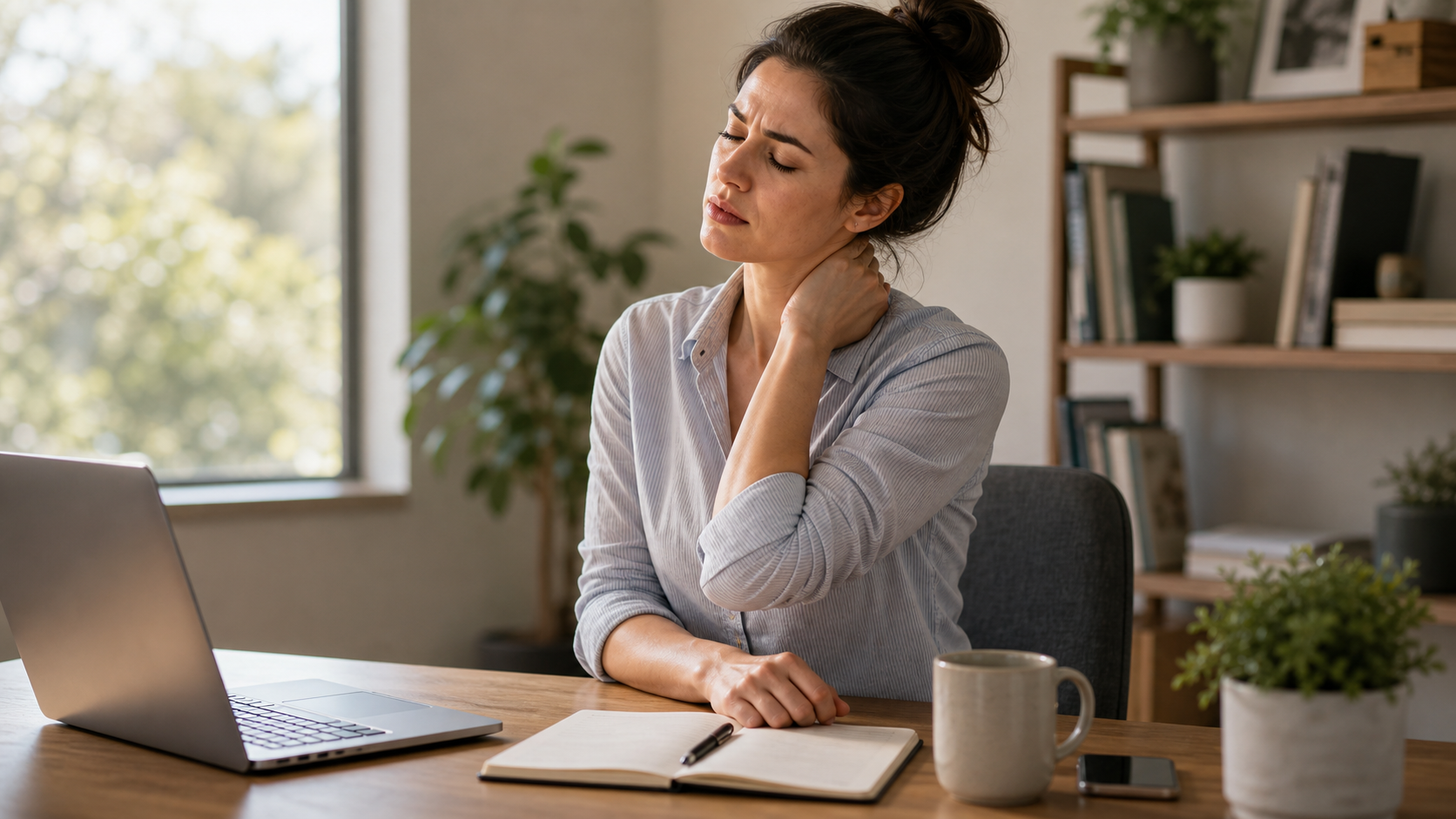
Most people think of inflammation as something that happens after a sprain or during a cold. But there’s another kind — quieter, slower, and almost impossible to pinpoint. It doesn’t flare dramatically. It just settles in, especially around the joints that bear the most load throughout the day: your hips from hours of sitting, your knees from the weight they carry, your lower back from the curve that deepens in a chair.
Stress adds its own layer. When the nervous system stays in a mild state of alertness — which is most of the modern workday — it triggers small inflammatory responses throughout the body. Not enough to register as a symptom. Enough to make tissue slightly less resilient, slightly more reactive, slightly less willing to move freely the next time you ask it to.
Long hours of sitting plus chronic low-grade stress create a kind of slow friction inside the body. Not dramatic. Not diagnosable by most measures. But real — felt in the tightness behind your knees when you finally get up, in the stiffness across your hips on the drive home, in the way your body takes a beat too long to come back online after a long afternoon.
Some afternoons feel heavier than they should. There’s a reason.
The Feeling You’ve Been Explaining Away

Here’s what makes afternoon stiffness so easy to dismiss: it’s not bad enough to stop you. You get up, you move around a little, it loosens. A few minutes pass and you’re mostly fine. So you chalk it up to sitting too long, remind yourself to stretch more, and move on. And the next day it happens again. And the one after that.
Over time, the range of motion that loosens up takes a little longer to return. The morning hips that used to feel free by the time you reached the kitchen now need a walk down the hall and back. The knees that used to be quiet now announce themselves on the stairs. Nothing catastrophic. Nothing requiring a doctor’s visit. Just a slow, steady narrowing of what ease feels like in your own body.
This is the pattern worth recognizing, not because it signals disaster, but because it’s telling you something useful. Your joints are not quietly failing. They’re responding to an environment that wasn’t designed for them. Hours of stillness, low-grade stress, and minimal circulation to the cartilage — these are inputs, not destiny. Change the inputs and you can change the pattern. But first, you have to stop explaining it away.
The gap between effort and ease is smaller than you think.
What Your Joints Actually Need to Stay Fluid
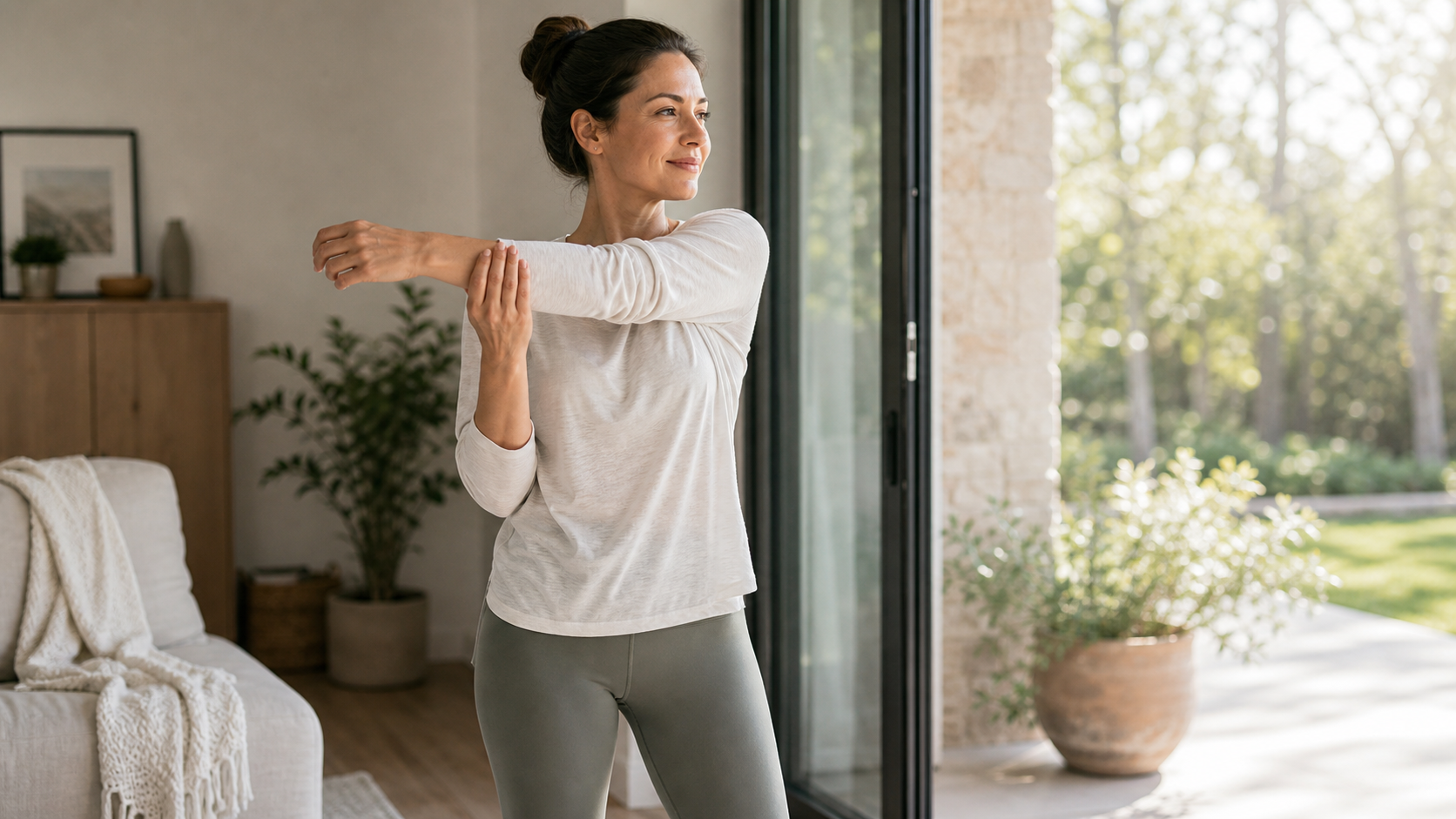
Movement is the first and most honest answer. Not aggressive exercise, not pushing through discomfort — just the regular, varied motion that keeps synovial fluid circulating and cartilage nourished. A short walk every ninety minutes. Standing while you think. A few minutes of gentle movement before you settle into a long stretch of work. These things matter more than most people realize, not as a wellness trend, but as basic maintenance for tissue that depends on motion to stay healthy.
Hydration plays a quiet role too. Synovial fluid is largely water-based, and joints that are consistently under-hydrated don’t produce it as efficiently. The simple habit of drinking enough water through the afternoon — not coffee, not a glass at lunch — actually supports the fluid environment your cartilage relies on to cushion and absorb impact throughout the day.
And then there’s inflammation. Even gentle, persistent inflammation interferes with joint comfort and the production of healthy synovial fluid. Addressing it isn’t about suppressing your body’s natural processes — it’s about reducing the unnecessary background noise that accumulates from stress, stillness, and the ordinary demands of a long day. When that noise quiets down, joints tend to move more freely, respond more easily, and recover more quickly from the hours they’ve spent under pressure.
Move Without the Negotiation
Stand up from your desk and just — go. No moment of adjustment required.
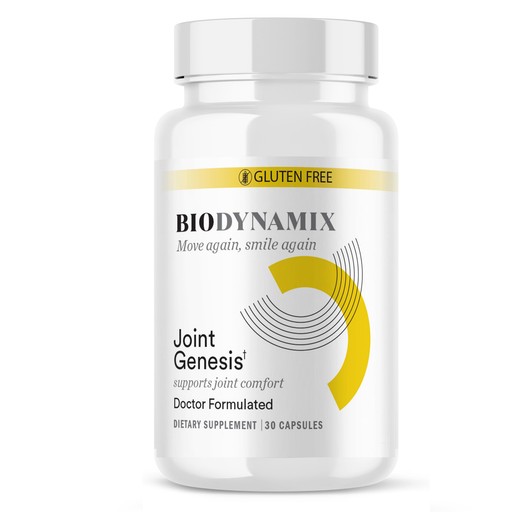
Joint Genesis supports the synovial fluid your joints depend on to stay lubricated through a long, still day — while quietly addressing the low-grade inflammation that builds from hours of sitting and stress. For people already doing the right things who still feel the friction, this is where the gap closes.
- ✓ Joints that respond when you ask — not a beat later
- ✓ Less residual tightness through the afternoon and commute home
- ✓ The kind of ease that makes you stop thinking about your hips
When the Right Support Changes What Afternoons Feel Like
Some people add movement breaks and feel a real difference within weeks. Others notice that even with the right habits, there’s still something not quite loose enough — a residual tightness in the hips, a stiffness that returns in the knees by mid-afternoon no matter what. That gap, between lifestyle effort and actual joint comfort, is where targeted support becomes meaningful.
Joint Genesis was built for exactly this kind of person. Not someone in crisis. Someone who’s doing the right things and still feeling the friction — in their hips during a long meeting, in their knees on the afternoon commute, in the general sense that their body is one step behind what their day asks of them. The formula works to restore the synovial fluid environment — supporting the body’s natural lubrication process — while addressing the low-grade inflammation that builds quietly through hours of stillness and stress.
This isn’t a product that numbs or masks. It’s one that works with the biology already inside you, gently reinforcing the systems your joints rely on. For people who’ve been explaining away their afternoon stiffness for months or years, it offers something that feels quietly significant: the experience of standing up and just — moving. Without the negotiation.
Standing up shouldn’t require a moment of adjustment.
The Afternoon Test Most People Never Think to Run
Here’s a simple way to know if this pattern is already present in your days. Think about 3:00 PM on a workday — specifically, the first time you stand up after a long stretch at your desk or in the car. How does your body feel in that first five seconds? Is it easy? Does it require a moment of adjustment, a hand on the desk, a slower straightening than you’d expect? Do you feel it in a specific place — one hip, both knees, the lower back? Now think about how that moment has changed over the past year or two. Has it gotten more pronounced? Does the loosening take longer? Has the area of stiffness expanded from one spot to two or three?
The body rarely shouts before it whispers for a long time. Afternoon stiffness is a whisper. And it’s worth listening to before the conversation gets harder to have.
Built for people already doing the right things — and still feeling friction.
What Changes When Your Joints Start Working With You Again
The thing most people don’t expect is how much the small moments shift first. Not a dramatic morning where everything feels new. More like: you stand up from your desk at 4 PM and walk to the kitchen without noticing your hips. You get out of the car after a two-hour drive and your knees don’t announce themselves. You take the stairs at the end of the day and there’s nothing to manage. These are quiet moments. But they add up to something that feels, honestly, like reclaiming a part of yourself you’d quietly accepted was gone.
Energy follows. When your body isn’t spending part of its background processing managing friction, compensating for tightness, or bracing against the small discomforts of daily movement — that energy goes somewhere else. Into focus. Into patience. Into the kind of physical confidence that makes you more willing to say yes to a walk in the evening, a longer errand, an extra hour of something that matters to you.
Joint health isn’t a niche concern. It’s woven into the texture of every ordinary day. How you move through a room. How you carry yourself after lunch. Whether the second half of your day feels like a continuation or a recovery. When your joints are supported, not just patched — the whole rhythm of your day changes. And that change, quiet as it starts, is the kind that stays.
Written by Elias Menden — for those who seek strength in every hour of the day
What would your afternoons feel like without the negotiation?