You know that moment — maybe you’re climbing stairs you used to take two at a time, or reading the same sentence for the third time because your brain won’t hold it — when a thought flickers through you like a cold draught: When did this start?
Not the tiredness. You’ve been tired before. This is different. This sits lower. Behind the muscles. Beneath the thoughts. It lives in a place you can’t stretch away or sleep off, because even sleep stopped doing what sleep is supposed to do. I know that moment because I lived inside it for almost a year before I understood what it was.
It wasn’t burnout. It wasn’t age — not in the way we usually mean. It was something happening at a level I couldn’t see, in cells I’d never thought about, on a clock I didn’t know was ticking.
And the strangest part? Once I found it, slowing it down turned out to be far simpler than I expected.
⸻
The Quiet Erosion No One Warns You About

Cellular aging doesn’t send you a warning. There’s no blood test that flashes red, no morning where your body formally announces it’s losing ground. It’s subtler than that — like the hum of a refrigerator you only notice once it stops.
For me, it showed up as a kind of greying-out. Afternoon fog that settled behind my eyes and wouldn’t lift. Workouts that bruised me for days. Sleep that logged eight hours but delivered something closer to four.
What I didn’t know — and what surprised me most — is that much of this has a name. Our cells carry chemical markers, tiny methylation patterns along DNA strands, that function almost like an internal clock. Researchers have found ways to read this clock, to measure whether your cells are aging faster or slower than your years suggest.
And here’s the part that changed everything for me: that clock isn’t fixed. It responds. To how you eat, how you move, and especially — as I would learn — to how deeply you sleep.
⸻
What Happens When the Lights Go Out
I used to think of sleep as downtime. A pause between productive hours. Something you survive on, negotiate with, compress when life gets full.
I was profoundly wrong.
Deep sleep — the kind where your brainwaves slow to a hum and your breathing settles into something almost tidal — is when your body does its most essential repair work. Cellular debris gets cleared. Hormones rebalance. Damaged proteins are broken down and recycled through a process called autophagy — the body’s own internal housekeeping. When that phase of sleep gets disrupted — by stress, screen light, a racing mind, a room that’s too warm — the whole repair cycle stalls. The mess accumulates. Your mitochondria, those microscopic power generators inside every cell, start sputtering. You don’t just feel tired. You age faster.
That was the insight that rearranged my priorities. Not a dramatic intervention. Just a simple, humbling recognition: the most powerful thing I could do for my cells happened while I was unconscious.
The Three Things I Changed
I didn’t tear up my life. I adjusted three threads, quietly, over the span of a few weeks. And then I watched.
Giving My Body a Window

I started with a gentle fasting rhythm — sixteen hours without food, meals between eleven and seven. No rigidity. No counting. Just space.
What fasting does, at the cellular level, is elegant. When the body isn’t processing food, it redirects energy toward repair. Autophagy ramps up. Old, underperforming cells get tagged for recycling. Inflammation softens. Within ten days, my afternoon slumps started losing their grip. My thinking felt less cluttered. Not sharper, exactly — clearer. Like wiping condensation from a window.
Once a week, I stretched the fast to twenty-four hours. Those mornings after felt like surfacing from deep water — light, clean, reset.
Honouring the Night
The bigger shift was sleep.
I committed to the same bedtime every night. Cooled the room down. Pulled the curtains until the darkness felt like velvet. No screens after nine. It sounds almost too simple to matter. But within three weeks, something had changed in the texture of my mornings. I wasn’t jolting awake anymore. I was rising — gradually, warmly, like sunlight crossing a floor.
Sleep That Actually Restores
Your body already knows how to repair itself — it just needs the night to cooperate
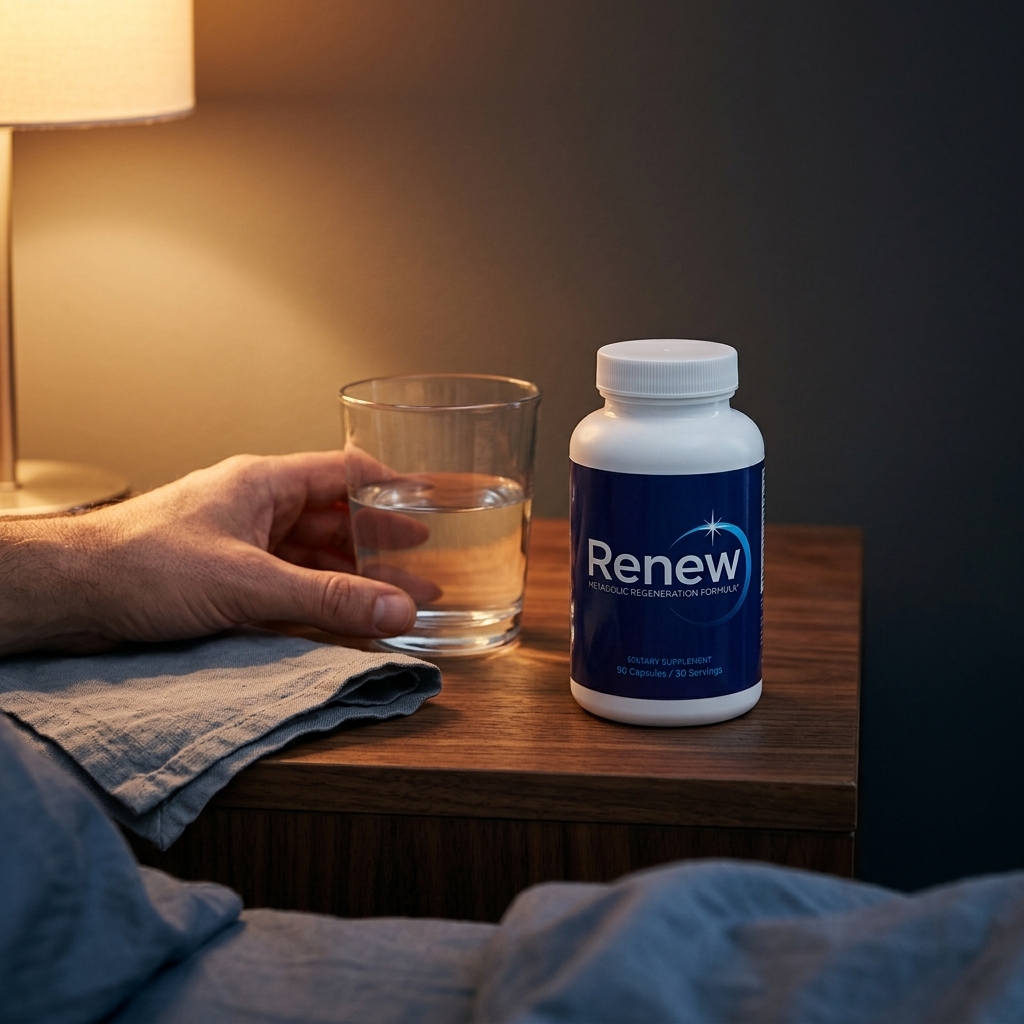
Renew is built for the deep phase of sleep — the window where cells clear debris, hormones rebalance, and real recovery begins. Magnesium, ashwagandha, L-theanine, and zinc work together to help your nervous system settle so your body can do what rest was always meant to do.
-
Wake feeling like sleep actually counted
-
Support the deep repair phase your cells depend on
-
One capsule, thirty minutes before bed — no complexity
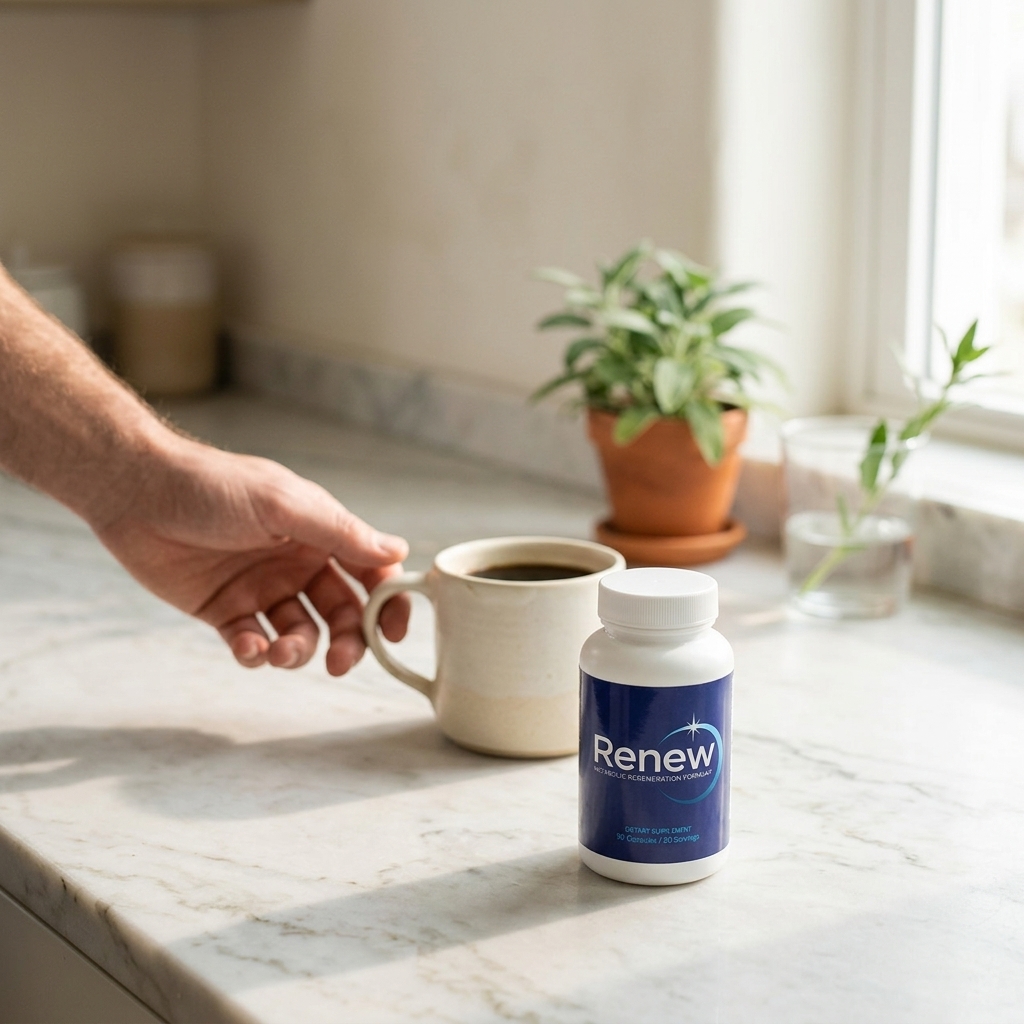
Around that same time, I started taking Renew before bed — a nightly supplement designed to support the deep sleep phase specifically. It contains magnesium, ashwagandha, L-theanine, and zinc — nutrients that encourage the nervous system to settle and help the body enter that critical regenerative window.
The first thing I noticed was how my shoulders unclenched about thirty minutes after taking it. Then, over the following nights, the quality of my rest deepened in a way I could feel the next morning. Not grogginess. Not sedation. Just a fullness to my sleep that had been missing for years.
Eating for Repair

I swapped the details more than the structure. More berries, more dark greens, more almonds — foods dense in antioxidants that help neutralise the oxidative stress that accumulates as cells age. I stopped eating anything heavy after six. I added wild-caught fish twice a week for its role in supporting cellular membrane health.
None of it felt like a diet. It felt like feeding a fire that had been starved of good fuel.
⸻
What Shifted by Week Two

By the second week, the most obvious change was my energy. Not a spike — I’ve had those before from caffeine and they always crash. This was more like a floor rising. My baseline felt higher. The dips were shallower. I woke with a kind of quiet momentum that carried through the morning without collapsing at noon.
Renew had become part of the rhythm by then — one capsule with water, thirty minutes before sleep. It fit beside the cool sheets and the darkened room like a final exhale at the end of the day. I noticed my mind settling faster. The spinning thoughts that usually followed me into bed began arriving later, dimmer, and then not at all.
By week four, my recovery after exercise had tightened noticeably. I could run in the morning and feel fine — genuinely fine — by evening. My skin looked different. Not younger, exactly. But less tired. Less dull. As though something underneath had started to glow again.
The Numbers Behind the Feeling

At the start of this experiment, I had my biological age tested — one of those panels that reads DNA methylation to estimate how fast your cells are aging compared to your calendar years.
My biological age came back at forty-two. Four years older than my birth certificate. That number didn’t scare me. It just confirmed what my body had been signalling. Three months later — after consistent fasting, reformed sleep, nightly Renew, and quieter eating — the gap had narrowed to two years. By six months, my biological and chronological age had met.
I’m not promising that. Everyone’s starting point is different. But the direction spoke volumes. My cells were responding. The clock had slowed.
Your Cells Notice the Difference
Deep sleep isn’t just rest — it’s where your body quietly rebuilds from the inside
Renew supports the nightly repair window your cells rely on. Targeted nutrients calm the nervous system and encourage the deep sleep phase where real restoration happens — not sedation, not grogginess, just sleep that does its full job. Night after night, the difference builds.
-
Support your body’s own cellular repair rhythm
-
Feel the shift in energy, recovery, and clarity
-
Simple nightly ritual — nothing to overhaul
⸻
What I Understand Now

Slowing cellular aging isn’t about extremes. It’s not cold plunges at dawn or ninety-dollar powders or punishing restriction. It’s about rhythm. Consistency. Paying attention to the basics your body has been asking for all along — and maybe never receiving.
- Deep sleep.
- Clean food.
- Gentle fasting.
- A few targeted nutrients that help the machinery of repair do what it was designed to do.
Renew was part of that for me — not a miracle, but a thread woven into a larger fabric. The thing that helped my sleep deepen enough for everything else to work. If your nights feel shallow, if your mornings feel heavy, if you’re wondering whether there’s something quiet and simple that could support the restoration your body is already trying to do — it’s worth exploring.
Not because someone sold you on it. Because something inside you recognised the need.
I took the stairs two at a time last Tuesday. Not to prove anything. Not even on purpose. My legs just moved that way, and I was halfway up before I noticed.
That flickering thought — when did this start? — doesn’t visit anymore. Not because I found some perfect answer. But because the question changed. It became: what if it’s already turning around?
It was. Quietly. Cellularly. One deep night at a time.
Written by Elias Menden — for those who seek steadiness.