You know that sound your office chair makes when you finally stand up after two hours? Mine was doing its job. My knees were doing something else entirely. Not pain, exactly. More like… negotiation.
Like they needed a minute to remember how standing worked. Like there was gravel somewhere inside that had to shift before I could walk to the kitchen without feeling forty years older than I actually am. And here’s the part that got to me: I started timing my bathroom breaks around when I thought I could stand without my coworker noticing the stiffness.
That’s when I knew something had to change.
Not because I was injured. Because I was already making my world smaller to accommodate joints that felt like they’d forgotten how to be joints. I tried the usual fixes.
- Joined a gym I went to four times.
- Bought resistance bands that lived in a drawer.
- Did a yoga video on Sunday and told myself I’d “get back to it” all week.
The problem wasn’t that these things didn’t work—it’s that I never stuck with them long enough to find out. Then I stumbled into something that changed the equation completely. A 15-minute daily routine for joint health that was short enough I couldn’t talk myself out of it.
And the thing that made it actually stick? Joint Genesis. Not as some miracle cure. But as the steady, reliable piece that made showing up feel easier. Like my joints got the memo that we were doing this gently, not heroically.
⸻
The day I realized I was waiting for the “right time” to start

If you want the bigger comparison before choosing a next step, see the guide to supplements for joint pain.

I spent months convinced I’d begin “properly” once I had more energy. More time. A better week. You know that bargain you make with yourself? “Once things settle down, I’ll really commit to taking care of my body.”
Except things never settle down. And meanwhile, I was standing up from my desk chair like someone twice my age, gripping the armrests for leverage, feeling my knees protest every single time. What broke the cycle wasn’t motivation.
It was finally understanding that my joints didn’t need a perfect workout plan—they needed a pattern they could count on. Fifteen minutes. Same time. Every day. Not because fifteen minutes was going to transform everything overnight. Because it was the only commitment I could actually keep.
And here’s what shocked me: once I made it small enough to be undramatic, my body started responding. Not in Instagram-worthy ways. In “I walked up the stairs without thinking about it” ways. The kind of changes you don’t announce but definitely notice.
⸻
Why Joint Genesis became the non-negotiable piece
I’ve tried enough supplements to know how this usually goes: You buy something with high hopes, take it inconsistently, then shove it to the back of the cabinet when you don’t feel instantly different. Joint Genesis didn’t follow that pattern. Maybe because I wasn’t expecting it to “fix” me.
I just wanted something that made movement feel less like I was fighting my own body. I take it before my routine—not as part of some complicated protocol, just as the thing I do first. And what I noticed, pretty quickly, was that the routine itself felt… easier.
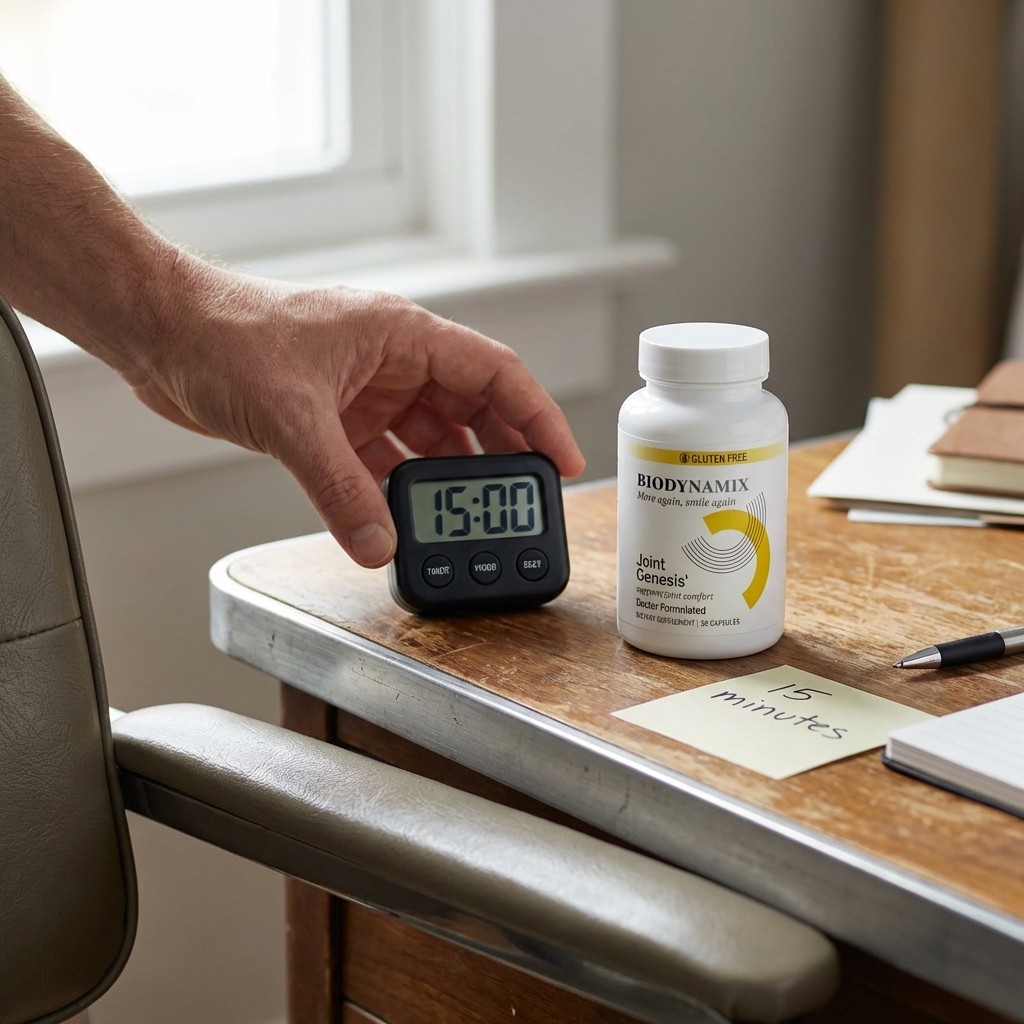
Make movement feel smoother
I take Joint Genesis first—because the “first minutes” stop feeling like a fight
Joint Genesis is built around Mobilee®, a hyaluronic-acid matrix that helps support synovial fluid lubrication—the slip your joints need for easy motion. Mobilee® contains hyaluronic acid, plus collagen and polysaccharides. For my 15-minute reset, this is the piece that makes showing up feel doable.
-
Less “creak” at the start
-
Smoother-feeling daily motion
-
Easier to keep the routine going
Not dramatically different. Just less creaky. Less “I’m not sure I can do this today.” More like my joints were actually with me instead of against me. Once you feel that shift—where movement stops feeling like a negotiation—you stop looking for something better.
You just keep showing up because showing up works.
⸻
The actual 15-minute flow that became my daily reset

Let me walk you through what this looks like in real time, because I think the simplicity is the whole point. This isn’t a “maximize your fitness” routine. It’s a daily movement for joint health routine designed for someone who’s still half-asleep, stiff from yesterday’s sitting, and not trying to become a new person.
I don’t blast music. I don’t psych myself up. I just set a timer and move.
Minutes 0–2: Wake up the system
I start with something embarrassingly simple: marching in place. Sometimes step-taps. Arm swings if I’m feeling it. Nothing vigorous. Nothing that requires thought.
Just enough movement that my body remembers, “Oh right, we move during the day.” This part matters more than it seems. It’s the bridge between “corpse in bed” and “person who can exercise.”
Minutes 2–5: Hip hinges and shallow squats
This is where things start to feel like actual joint work. I do hip hinges—like I’m closing a car door with my hips, keeping my back long. Then some shallow squats, nowhere near the floor, just enough that my knees remember they bend.
And here’s the thing I didn’t realize until I started doing this daily: my knees don’t work alone. When my hips are tight and my glutes are asleep, my knees take all the load. This section is about waking up the support system so my knees can stop doing everyone’s job.
Minutes 5–8: Upper body (because posture affects everything)
Most joint routines ignore the upper body like it doesn’t matter. But when your shoulders are rounded and your chest is collapsed—which, let’s be honest, describes every desk worker after lunch—your whole body compensates.
I do wall push-ups. Maybe ten. Then I grab a resistance band and do slow pull-aparts, focusing on squeezing my shoulder blades together. It’s not about building muscle. It’s about reminding my body how to hold itself upright without effort.
And I swear, when I do this consistently, I feel taller. I walk differently. My lower body doesn’t have to work as hard to keep me balanced.
Minutes 8–11: Core stability (the quiet power)

This is the section I used to skip because it felt boring. Now it’s the one I never miss. I hold a light weight or band in front of me and rotate slowly—left, center, right. Resisting the pull. Keeping everything controlled and steady.
This teaches my core to stabilize my movement, which matters more than you’d think for joint flexibility. Because when your core is weak, your movement gets sloppy. And sloppy movement means your joints are absorbing forces they weren’t designed to handle. I’d rather spend three minutes teaching my middle to do its job than spend three weeks dealing with a flare-up.
Minutes 11–15: Dynamic stretches and short holds
Now I move into leg swings—front to back, side to side. Arm circles. Shoulder rolls. Gentle neck stretches. Then I finish with two quick holds:
- Hamstrings on the floor (30 seconds)
- Kneeling hip flexor stretch (30 seconds each side)
Fifteen minutes. Done. And the wild thing? I don’t feel “worked out.” I feel like I just oiled all the parts that were squeaking.
I feel ready for my day instead of bracing for it.
⸻
Morning mobility vs evening mobility (and why I do both sometimes)
I used to think I had to pick one time and stick with it forever. Now I think of timing like a tool—different times serve different purposes.
Morning: the reboot
Morning is when my body feels like it hasn’t fully loaded yet. Everything’s tight. Everything’s slow. The routine in the morning is like hitting refresh.
It wakes me up better than coffee, honestly. And there’s something about keeping that promise to myself first thing—before emails, before the day starts making demands—that makes me feel steadier all day.
Evening: the unwind
Evening is different. It’s not about waking up, it’s about releasing. If I’ve been hunched over a computer for eight hours, or standing too long, or carrying tension in my shoulders, a shorter version of the routine at night changes everything.
Even five minutes of hip openers and shoulder rolls makes me sleep better. Most days, I do the full thing in the morning. But on days where I feel extra stiff, I’ll do a mini version at night.

Support comfort every day
When my day leaves me tight, this is what I don’t skip
Joint Genesis isn’t a complicated “protocol.” It’s a daily joint support capsule that combines French maritime pine bark, ginger root, Boswellia serrata, and BioPerine® (black pepper extract)—a stack made to support everyday comfort and help your body actually use what you take. This pairs perfectly with my morning-or-evening mobility reset.
-
Supports a calmer, looser feel
-
Helps you stay consistent
-
Backed by a focused ingredient stack
And on days where I really don’t want to do anything at all? That’s when having Joint Genesis as my anchor matters most. Because it’s the one steady piece I don’t have to think about. I take it, and then showing up for the movement feels less like forcing myself and more like following through.
⸻
The food and hydration piece nobody talks about

I’m not going to pretend I eat perfectly. I don’t. But I did notice something: my joints felt worse on days where I was barely drinking water and eating whatever was fastest.
Not because I was eating “bad” foods. Because my body didn’t have the raw materials it needed to stay supple. So now I keep it simple:
- Water first thing.
- Not after I “get around to it.”
- First thing.
- If I’m feeling extra dry and tight, I’ll add electrolytes.
- Not fancy ones.
- Just the basics.
And I try to eat in a way that supports my joints: fatty fish when I can swing it, chia seeds or walnuts when I can’t, colorful vegetables, enough protein that I’m not living on crackers and caffeine. I’m not tracking macros. I’m not meal-prepping on Sundays. I’m just trying to give my body what it needs to do the work I’m asking of it.
And honestly? The hydration piece alone made a noticeable difference. Joints are basically hinges that need lubrication. If you’re chronically under-hydrated, no amount of stretching is going to make them glide smoothly.
The unexpected part: this changed how I feel about my body

This is the part that goes beyond joints. When your body feels unreliable, you start treating it like the enemy. You brace for it. You plan around its limitations. You stop trusting that it’ll cooperate when you need it to.
But when you show up for your body consistently—when you give it a small, sustainable rhythm that makes it feel better—that trust starts coming back. I stopped waking up wondering what kind of day my knees were going to let me have.
I started assuming I’d feel fine. And then I did. And once you stop fearing movement, you move more naturally. More stairs without thinking. More walking because you feel like it, not because you’re forcing yourself. More casual squats to pick things up off the floor.
That’s what this really gave me back: the ability to live in my body without constantly negotiating with it.
Why I don’t second-guess it anymore
If you’re in the loop I was in—constantly wondering if you should try something else, do more, wait until you feel better, research one more thing—I’ll tell you what finally broke me free: Joints don’t get better from perfect plans. They get better from consistent patterns.
My pattern is simple:
- A 15-minute daily routine for joint health that I can do even when I’m tired, unmotivated, or running late.
- And Joint Genesis before I move—not as some complicated biohack, just as the quiet, steady thing that makes the whole routine feel easier to show up for.
That’s it. That’s what changed everything. I don’t overthink my mornings anymore. I don’t wake up and wonder if today’s the day I’ll finally commit to taking care of my joints. I just do the thing I’ve been doing.
And my body responds.
⸻
If you want to start tomorrow
You don’t need more time. You don’t need a better week. You don’t need to become someone who “loves working out.” You need fifteen minutes and a rhythm you can maintain.
Try the flow once. Then try it again the next day. Let your joints learn that you’re showing up. And if you want that same “my body’s actually cooperating” feeling that made everything click for me, consider adding Joint Genesis before you move.
Not as a dramatic intervention. As a steady anchor. Because the best routine isn’t the one that looks impressive on paper. It’s the one that brings you back to your body—every single day—without a fight.
—
Written by Elias Menden — for those who seek steadier movement, clearer energy, and a body that feels like home again.