I knew something was wrong when I started avoiding my own hands. Not in some dramatic way. Just… small things. Like I’d reach for a jar lid and think, Maybe I don’t need pickles today. Or I’d go to open my laptop and my knuckles would feel thick—not painful exactly, just slow to wake up. Like they’d spent the night clenched and forgot how to soften.
The morning it really hit me, I was standing at the kitchen sink with my hands under warm water, watching steam curl up, and my fingers still felt swollen. Puffy. Like I was wearing invisible gloves that didn’t quite fit. I looked down and thought: When did this become normal?
Because here’s the thing—I wasn’t limping. I wasn’t in agony. I was just… always negotiating. Always adjusting. Always planning my day around what my body might or might not let me do without complaint.
- Tie my shoes? Sure, but let me find a chair first.
- Take the stairs? Maybe later, when my knees feel more cooperative.
- Sleep through the night? Not if my hips had anything to say about it.
I was functioning. I was fine. But I was also quietly, constantly tired of my own body. That’s when I started looking into how to reduce chronic inflammation without medication—not because I wanted to become a wellness warrior, but because I was tired of waking up like I’d already run a marathon before breakfast.
⸻
The moment I stopped treating inflammation like the enemy

For months, I saw inflammation as the problem. Something loud. Something broken. Something I needed to fix or silence or shut down with the right hack. I tried elimination diets. I bought fancy teas. I read articles that promised miracles if I just stopped eating nightshades or started drinking celery juice at 6 a.m. Some things helped a little. Most things helped for about three days and then quietly stopped working.
And then one night, I read something that shifted everything:
Inflammation isn’t the villain. It’s the smoke alarm.
Not always accurate. Not always helpful. But never random. It’s your body saying: “Something here isn’t working. Something is keeping me on high alert. Can you help me figure out what?”
Once I saw it that way, I stopped asking, “How do I make this go away right now?” And started asking, “What keeps setting this off?” That question changed the entire game.
What chronic inflammation actually steals from you (and it’s not just comfort)

Here’s what nobody tells you about living with low-grade inflammation: It’s not just the stiffness. It’s not just the puffiness or the brain fog or the weird soreness after a normal Tuesday. It’s the way you start shrinking your life in tiny, invisible ways.
You stop trusting your energy. You plan around your body instead of with it. You say yes to things and then quietly hope your knees don’t sabotage you halfway through. You wake up needing “a minute” before you feel like a person. You read the same work email three times because your brain feels like it’s wading through fog.
You snap at people you love, not because you’re angry, but because everything feels harder and you’re just… tired. That’s the part that got to me. Not just the aches—it was what they stole from my confidence. From my sense of ease in my own skin. I wanted to feel like my body was on my side again.
The foundations that actually moved the needle (and how I built them without becoming perfect)
I tried a lot of things. Some worked. Some were expensive wastes of time. Some worked for a week and then my body shrugged them off like they’d never mattered.
But three foundational shifts gave me the biggest return—not because they were complicated, but because they finally started working together instead of against each other:
Sleep that actually restores.
Food that steadies instead of spikes.
Movement that circulates instead of punishes.
None of these were new ideas. But the way I implemented them? That’s where everything clicked.
Sleep: when I stopped collapsing and started recovering

I used to think sleep was just… what happened when you got tired enough. You fell into bed. You hoped for the best. You woke up either feeling okay or feeling like garbage, and that was basically luck.
But once I started paying attention, the pattern was impossible to ignore: When my sleep was broken or shallow, my body was louder the next day. Creakier. More reactive. More inflamed. When my sleep was deep and uninterrupted, I woke up feeling like a person instead of a question mark.
So I stopped trying to “earn” sleep or “push through” on four hours like some kind of badge of honor. I treated bedtime like a recovery protocol.
My simplest sleep anchors (that actually stuck):
- Dim the lights an hour before bed. Not pitch black—just lamps instead of overhead lights. It sounds stupid-simple, but it works.
- A hot shower at night. Not for cleanliness—for the signal. The warmth relaxed my muscles and told my nervous system, “We’re winding down now.”
- Screens away for the last 20 minutes. Not an hour. Not some monk-level digital detox. Just 20 minutes where I let my brain idle.
- Slow breathing while lying down. Hand on my belly. Letting my ribs soften. Letting my jaw unclench.
The goal wasn’t to sleep like a baby. The goal was to stop shocking my system right before I asked it to repair itself.
Food: the day I stopped chasing “the perfect diet” and started eating for calm

This is where I made the most mistakes. Because I wanted a magic answer. I wanted someone to hand me a meal plan that would fix everything in 30 days.
So I tried keto. I tried paleo. I tried anti-inflammatory protocols that banned seventeen different foods and left me eating plain chicken and spinach like some kind of penitent monk. And you know what? I lasted about nine days before I cracked and ate an entire sleeve of crackers standing in front of the pantry at 10 p.m.
What finally worked was embarrassingly boring: I built meals around steady blood sugar and real nutrients—not excitement, not trends, not punishment.
That looked like:
- Protein first. Eggs. Greek yogurt. Leftover chicken. Something that kept me full so I wasn’t snack-hunting by 11 a.m.
- Colorful plants most days. Not as a rule. Just as a quiet baseline. Berries. Leafy greens. Roasted vegetables that actually tasted good.
- Fats that felt satisfying. Olive oil. Avocado. Nuts. Fatty fish when I remembered to buy it.
- Fewer refined carbs. Not zero. Just fewer. Because toast for breakfast, crackers for lunch, and pasta for dinner left me feeling puffy and exhausted by 9 p.m.
I still ate normal food. I still had pizza. I still enjoyed dessert. But I stopped doing the thing where I’d eat for convenience all day and then wonder why my body felt like it was staging a revolt.
A steady body likes steady inputs. It’s really that simple and really that hard.
Movement: the shift from “crushing it” to “feeling better tomorrow”

When you feel inflamed, intense workouts are a gamble. Some people thrive on boot camps and HIIT and crushing their goals. Good for them. I’m not anti-workout.
But I had to be honest: my body wasn’t responding well to “all or nothing.” Hard workouts left me sore for days—not in the good, productive way, but in the “why does everything hurt” way.
So I started moving like someone who wanted to feel better tomorrow—not just accomplished today.
My go-to movement rhythm:
- A 15–25 minute walk outside. Especially after meals. Not power-walking. Just moving. Breathing. Letting my joints circulate instead of stiffen.
- Light strength work a few times a week. Gentle. Controlled. Not punishing. Just enough to remind my muscles they still worked.
- Beginner-friendly yoga or stretching on stiff days. Nothing Instagram-worthy. Just me on the floor, trying to unfold.
One of my favorite moments was realizing that movement could reduce pain instead of cause it. Like finally turning on a faucet and letting all the stuck tension drain out.
⸻
The “4th pillar” nobody wants to admit: stress is part of the inflammation story
I wanted inflammation to be only about food. I wanted it to be only about sleep or movement or some supplement I hadn’t discovered yet. But stress was the quiet drummer in the background, keeping my whole system on edge.
Not just “I’m busy” stress. Not just work deadlines or big life events. It was the constant internal pressure:
- Rushing even when I didn’t have to.
- Holding my breath while reading emails (yes, really—I started noticing this).
- Staying mentally “on” long after the workday ended.
- Feeling guilty for resting, like rest had to be earned instead of just… allowed.
When your nervous system lives in that state, your body doesn’t feel safe enough to heal. It’s like trying to sleep with the fire alarm going off. Your system can’t relax because it thinks something urgent is always happening.
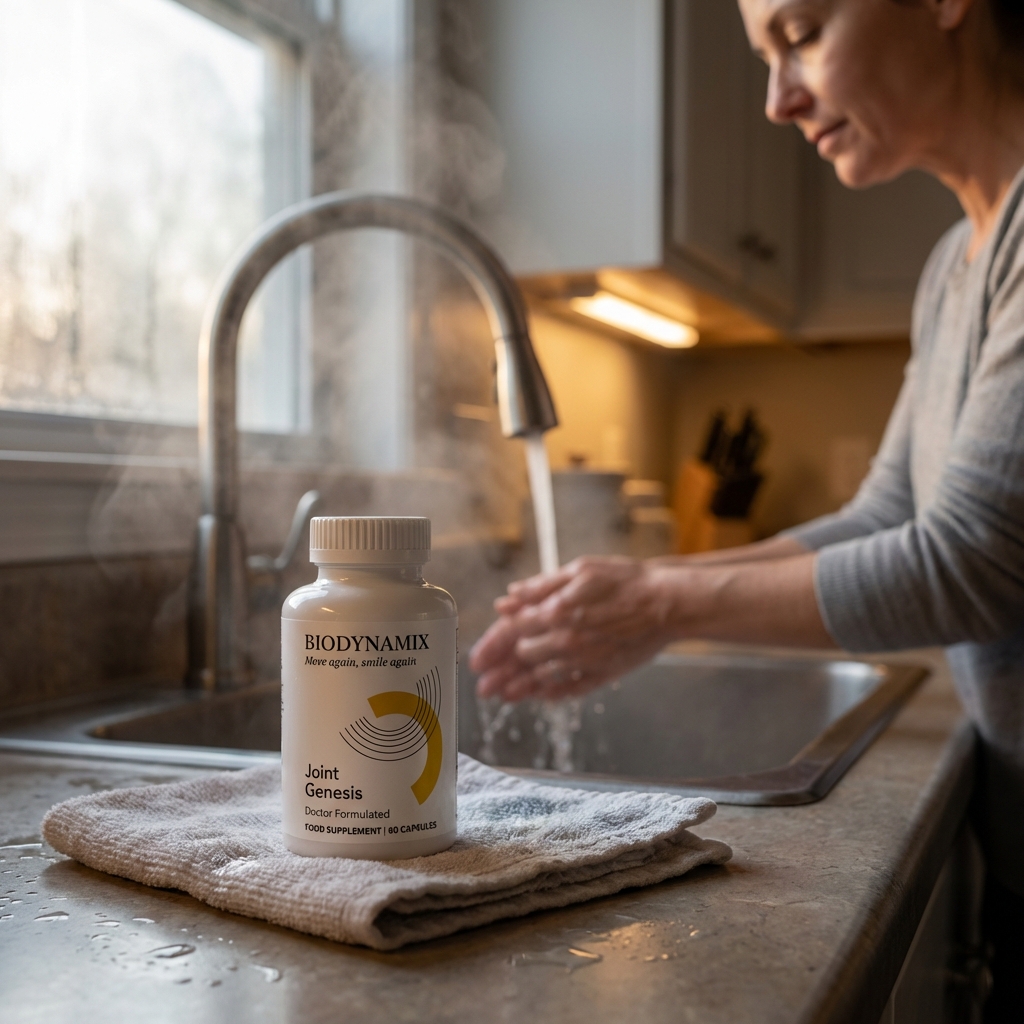
Help Your Joints Glide
If mornings feel “sticky,” this is the support I’d keep
Joint Genesis is built around Mobilee®, a concentrated complex that provides hyaluronic acid, collagen, and polysaccharides—the kind of building support your joints use for smoother, better-cushioned movement. In plain words: it helps support the “joint lubrication” side of the inflammation story, so you wake up less stiff and move with less friction.
-
Supports synovial fluid lubrication
-
Supports flexibility and smoother motion
-
Helps mornings feel less creaky
So I built tiny “off-ramps” into my day. Nothing dramatic. Nothing time-consuming.
- One minute with my face in the sun. Even through a window on cold days. Just light and warmth.
- A slow exhale before I got out of the car. Literally just sitting there for five seconds, breathing out, letting my shoulders drop.
- A one-line journal question: “What’s actually urgent today?” (Usually? Nothing.)
- Dropping my shoulders on purpose. Because they were always creeping up toward my ears without permission.
These weren’t wellness trends. They were survival skills. And slowly—very slowly—my body stopped treating everything like an emergency.
The supplement I kept (because it felt steady, not hypey)
I’m careful with supplements. I’ve been burned by big promises. By miracle cures that worked for two weeks and then quietly stopped. By expensive bottles that sat in my cabinet doing absolutely nothing.
But after I had the basics in place—sleep, food, movement, stress—I still wanted something that supported my joints and daily comfort in a consistent way. Not a miracle. Not a quick fix. Just… steady reinforcement.
That’s when I tried Joint Genesis. I didn’t expect fireworks. I wasn’t looking for an overnight transformation. I just wanted something that made the foundational work feel a little easier.
And here’s what I noticed (not in three days, but over a few weeks):
- Mornings felt less creaky. I still had to wake up, obviously. But my body didn’t feel like it needed a negotiation period before it agreed to move.
- My joints felt more lubricated. Less grinding. Less stiffness. More like they remembered how to glide.
- I stopped thinking about my body so much during the day. Which, honestly, is a kind of freedom I didn’t know I was missing.
That’s what made it worth keeping. It didn’t replace the lifestyle shifts. It just made them easier to stick with—because my body felt less reactive while I was building new habits. And there’s something deeply relieving about that. When your plan stops feeling like a fight.
Turn Down The Alarm
When your body’s on high alert, support should feel steady—not extreme
Joint Genesis pairs targeted botanicals: Boswellia serrata, Ginger root, and Curcumin (turmeric extract) to support a healthy inflammation response, ease that “puffy/stiff” feeling, and help movement feel more comfortable. It also includes BioPerine® (black pepper extract) to help your body absorb what you’re taking. This is the layer I’d choose when I want support that matches a real-life routine.
-
Supports healthy inflammation response
-
Supports comfort and flexibility
-
Includes BioPerine® for absorption
⸻
What “reduce chronic inflammation without medication” actually looks like in my life (simple, not perfect)
I don’t live like a monk. I don’t eat like a robot. I don’t track macros or optimize every hour or wake up at 5 a.m. to meditate in silence.
But I do protect a few non-negotiables that keep my system calm:
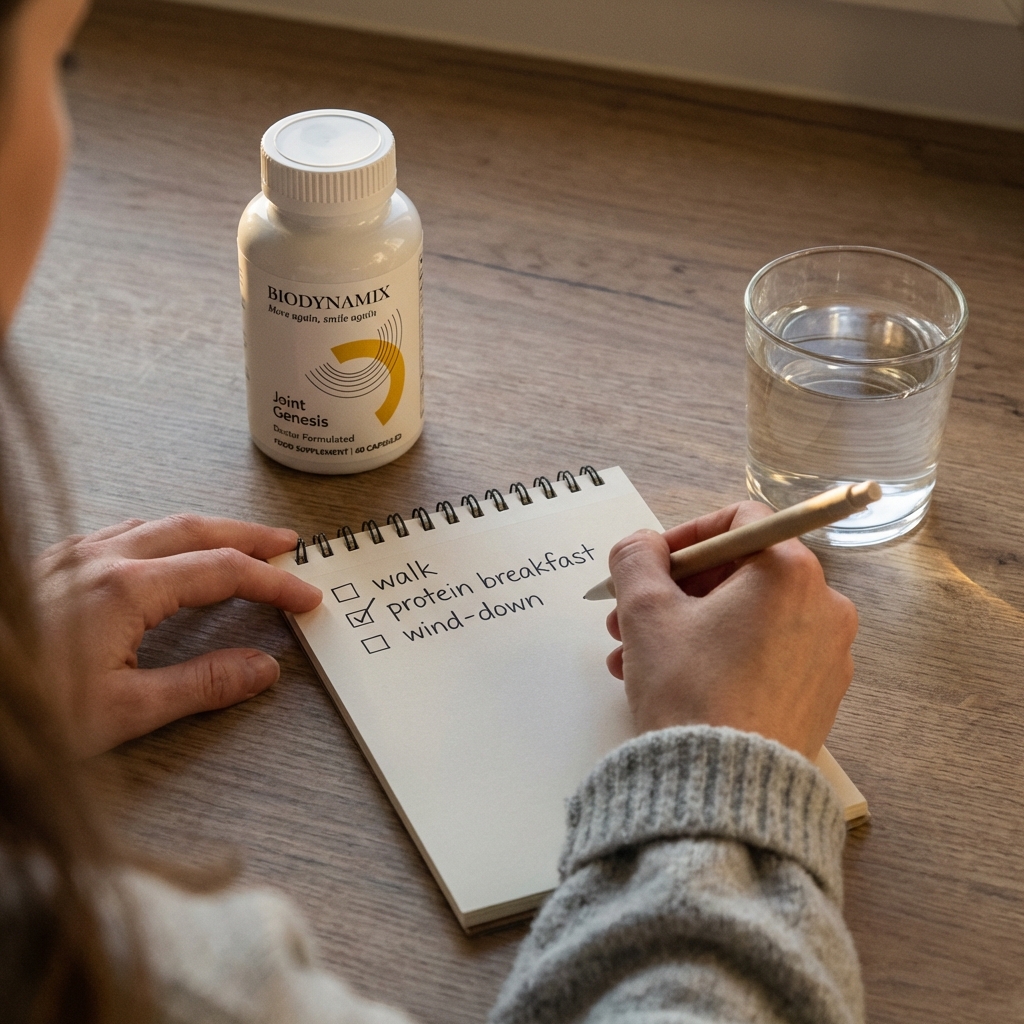
- Water and a few slow stretches when I wake up. Before I even think about coffee.
- Protein at breakfast most days. Even if it’s just Greek yogurt with berries.
- A walk most days. Even if it’s only ten minutes. Even if it’s just to the mailbox and back.
- A bedtime wind-down that actually winds me down. Dim lights. Hot shower. No phone scrolling.
- Joint Genesis as part of my daily rhythm. One thing I don’t have to think about—it’s just there, supporting the rest.
- One small stress reset before the day runs away with me. A breath. A pause. A moment where I let my body remember it’s safe.
That’s it. Not extreme. Not restrictive. Not perfect. Just steady.
The real win wasn’t less pain—it was getting my body back on my side
The best part of learning to reduce chronic inflammation without medication wasn’t even the physical changes. It was getting my confidence back. The feeling that I could make choices today that helped tomorrow. That my body wasn’t broken or betraying me—it was just communicating. And when I listened (gently, consistently), it softened.
If you’re in that place where you’re quietly tired of negotiating with your own body every single day, I hope this gives you a starting point. Build the basics. Stack the small wins. And if you want a simple layer of support that feels steady instead of hypey, something like Joint Genesis can fit into the story without taking it over.
Because you don’t need a perfect life to feel better.
You just need a life your body can finally exhale inside.
Written by Elias Menden — for those who seek steady energy.
Related reading
- When Your Body Keeps Score: What I Learned About Inflammation and Burnout
- Signs of Chronic Inflammation You Might Be Ignoring — And the One Shift That Changed Everything
- Best Daily Supplements for Stress-Induced Inflammation: How One Night Softened My Days
- The Surprising Link Between Fatty Acids and Inflammation Control