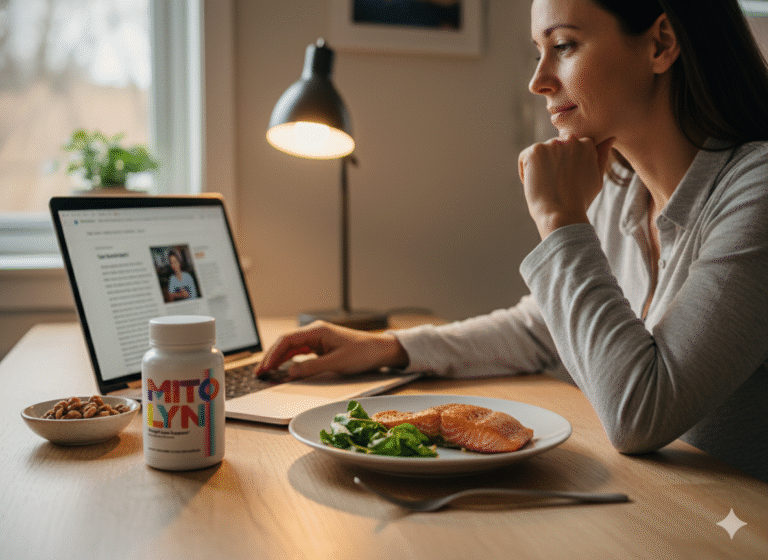
There’s a specific kind of fear that shows up when you don’t trust your own energy anymore.
Not “I’m tired.” Not even “I need a nap.”
More like: Any minute now, the floor could drop out.
After COVID, that’s what my afternoons became. I’d be mid-task—tabs open, brain trying to cooperate—and then the switch would flip. My thoughts got syrupy. My arms felt oddly heavy. The laptop fan sounded louder than it should. And I’d stare at the same sentence for so long it stopped meaning anything.
If you’ve lived inside long COVID energy crashes, you know how strange they are. It isn’t laziness. It isn’t a motivation problem. It’s the feeling of your body pulling the emergency brake while your life keeps asking for motion. Fatigue and brain fog are common in Long COVID, and many people report symptoms that worsen after physical or mental effort.
I didn’t want a dramatic plan. I wanted something I could repeat—something gentle enough that my nervous system wouldn’t take it as a threat.
So I ran a quiet experiment.
Not a miracle chase. Not a “biohack my way out of this” obsession.
Just: small levers, tracked honestly, and adjusted like I was learning a new language—my body’s language.
What long COVID energy crashes are really telling you

At first, I did what most people do: I went looking for answers that would show up on paper.
Bloodwork. Thyroid. Basic heart checks. The kind of tests that are great at catching obvious danger—and weirdly bad at explaining why you feel like your internal battery is broken.
Everything looked “fine.”
Meanwhile I wasn’t fine. My legs felt weaker than they should. My head had that cotton-stuffed feeling. And if I pushed too hard one day—even mentally—the next day could punish me with a full-body slump that didn’t match the effort.
That pattern matters.
For some people after COVID, there’s a phenomenon called post-exertional malaise (PEM)—symptoms getting worse after exertion that used to be tolerable. It can show up after physical effort, cognitive work, emotional stress… even social time.
When I finally learned that “more willpower” wasn’t the missing ingredient, something softened in me.
Because if your system is flaring after effort, the goal isn’t to prove you’re strong.
The goal is to stop triggering the flare.
That’s when my experiment got simple:
- Make sleep more restorative.
- Lower the inflammation load I was adding through food.
- Respect the energy envelope instead of constantly stepping outside it.
- Support recovery so the crashes had less room to take over.
That last piece—supporting recovery—became the turning point I didn’t expect.
The moment I stopped guessing and started tracking

I used to treat sleep like a moral virtue. If I slept “right,” I’d be fine. If I slept “wrong,” I deserved the consequences.
Post-COVID humbled that mindset fast.
So I tracked it—nothing fancy. Bedtime. Wake time. Night wakings. And one honest question every morning:
Do I feel even slightly more restored than yesterday?
Within a week, the pattern was blunt:
- On nights I fell asleep late and woke up fragmented, the next day wasn’t just tired—it was crash-prone.
- On nights I got steady, uninterrupted blocks, my brain fog was still there… but the edges were softer.
What surprised me most was how much my body cared about consistency more than perfection. A predictable rhythm felt like a safety signal.
And I needed every safety signal I could get.
Food as friction (and how I reduced it)

I didn’t overhaul my entire diet overnight. I wasn’t trying to become a new person.
I just wanted my lunch to stop acting like a trapdoor.
So I treated food like “friction.” Some meals made my body work harder—digestive heaviness, inflammation, blood sugar swings. Other meals felt like… less drama.
I leaned into the least dramatic foods I could tolerate:
- warm, simple proteins
- cooked vegetables (easy on the system)
- berries and nuts
- olive oil, salmon, sardines when I could
- soups and stews that felt like they asked less of my digestion
And I backed away from the usual suspects that spiked me and then dropped me:
- sugary drinks
- processed snacks
- big refined-carb lunches that made my eyelids feel like they had weights sewn into them
A few swaps that actually felt doable:
- oatmeal with nuts and fruit instead of sweet cereal
- sparkling water with lemon instead of cola
- leafy greens + fatty fish as a steady lunch base
The result wasn’t fireworks. It was smoother.
Fewer “why am I suddenly underwater?” moments at 2 p.m.

Sleep Deeper. Crash Less.
If afternoons feel like a trapdoor, start by fixing what happens at night
Renew is a sleep-focused formula made to support deeper, more restorative sleep. Take it before bed to help your body settle, stay down longer, and wake up with a steadier baseline. When nights do more recovery work, daytime pacing gets easier.
-
Less wired-tired at night
-
Smoother mornings, softer fog
-
Fewer sharp energy drop-offs
The part I didn’t expect: making nights count again
Here’s the honest truth: even with better sleep habits and calmer meals, I still felt like my system was running on a fragile charge.
And that’s where I got curious about one specific angle:
What if my nights weren’t doing enough recovery work?
Not in a mystical way—just in the practical sense that restorative sleep is when your body does a lot of its repair and reset. And many people with post-COVID symptoms report sleep disruption right alongside fatigue and cognitive issues.
I didn’t want a complicated stack of supplements. I wanted one support that fit the logic of what I was already doing: protect the recovery window.
That’s when I tried a sleep-focused formula called Renew—not as a “fix,” but as a way to help my system sink into deeper rest. (The reason I picked it: it’s specifically positioned around improving deep, restorative sleep—the part I felt I was missing.)
Early hint, before I knew anything
The first night I took it, nothing dramatic happened. No instant bliss. No cinematic knockout.
What I noticed instead was subtle:
My body felt less wired-tired.
Like the part of me that kept checking the door for danger finally sat down.
That alone was worth paying attention to.
Mid-experiment: the strange relief of fewer “dead battery” days
After about a week, I had two shifts that made me pause:
One: I woke up with less of that “cement head” feeling. Still not energized—just less foggy at the edges.
Two: my energy dips weren’t as sharp. The crashes didn’t disappear, but they lost some of their violence. They felt… negotiable.
And that changed my behavior in a way that mattered.
When you’re terrified of crashing, you either over-rest (and feel trapped) or over-push (and pay for it). But when the crashes soften, you can start pacing like a sane person.
That’s what happened.
I got better at the small decisions:
- stopping a task before my brain started flickering
- taking breaks like they were part of the plan, not a failure
- treating “a little better” as evidence, not as something to dismiss
This is where the emotional piece kicks in.
Because long COVID energy crashes don’t just drain your body. They mess with your confidence. They make you second-guess your discipline, your character, your grit.
A steadier baseline—even a modest one—gives you something precious back:
trust.
And trust is fuel.
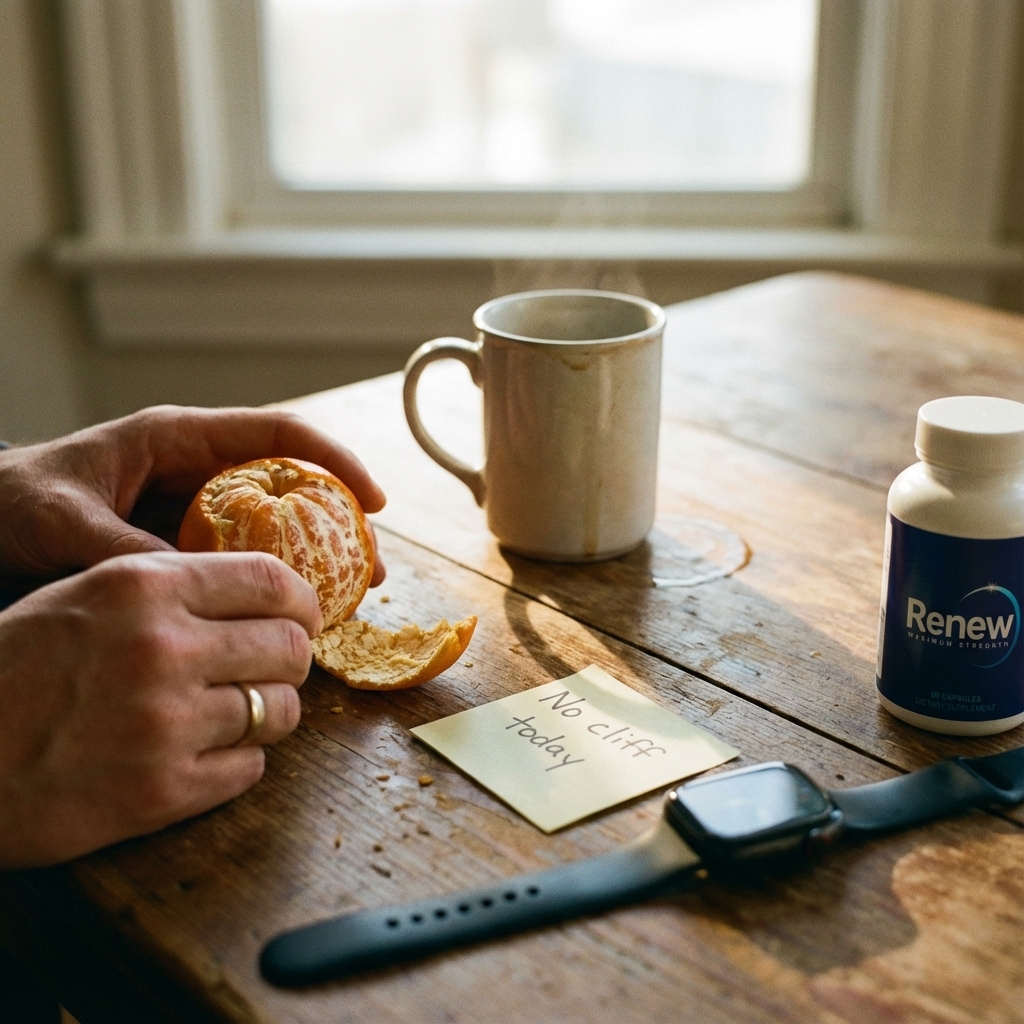
Renew Your Baseline
You don’t need perfect days—just fewer crashes that knock you flat
Buy Renew if you’re serious about making sleep your recovery engine. It’s designed to support deep, restorative rest—so you wake up steadier and your afternoons feel less like a cliff edge. One bedtime step. Real nightly support.
-
Helps you settle into sleep
-
Supports deeper nightly recovery
-
Builds steadier day-to-day rhythm
The “rules” I followed without turning it into a rigid life

I’m careful with rules now. Rules can become another stressor.
But I did keep a few guiding ideas close, mostly because they reduced flare-ups:
- I tracked sleep for two weeks before changing too much at once.
- I treated lunch like a stabilizer, not a reward.
- I paced like PEM was real—because for me, it was. (PEM is a recognized pattern of symptom worsening after exertion. )
- I used Renew as part of the recovery arc—helping nights feel more restorative, which made the daytime experiment easier to maintain.
And I stayed patient in a very specific way:
Not passive patience. Observant patience.
The kind where you watch for micro-wins:
- a longer stretch of focus before the fog
- fewer “have to lie down” moments
- waking up feeling less like you got hit by a truck emotionally
A few questions I kept asking myself
How soon can you notice change?
For me, the first hints were subtle and showed up inside a week—mostly around sleep quality and how sharp the crashes felt.
Can you still move your body while you’re rebuilding?
Yes, but pacing matters. The point isn’t to prove capacity; it’s to avoid the boom-bust cycle that leaves you paying interest later.
What if your tests look “normal,” but you still feel awful?
You’re not imagining it. Long COVID is known for a wide range of symptoms—including fatigue, cognitive issues, and PEM—that don’t always match standard labs.
What finally moved the needle for my long COVID energy crashes

If I had to describe the real change, it wasn’t “I got my old life back.”
It was more like: I stopped bleeding energy all day.
My system became less reactive. My afternoons stopped feeling like a cliff edge. And even on hard days, I didn’t feel as trapped inside the crash.
That’s the win people don’t talk about enough.
Not perfection—stability.
Sleep tracking gave me clarity. Food changes reduced friction. Pacing kept me from poking the bear.
And Renew helped my nights feel like they were actually doing their job again—restoring, not just passing time.
The quiet truth at the end
Long COVID energy crashes can make you feel like you’re failing at life.
But most of the time, you’re not failing.
You’re adapting to a body that’s asking for a different pace—and a deeper kind of support.
If this resonates, and you’re trying to build steadier days without turning your life into a science project, Renew might be a gentle next step in the same direction: making recovery feel more available—night after night, not just on lucky days.
Written by Elias Menden — for those who seek steadiness.