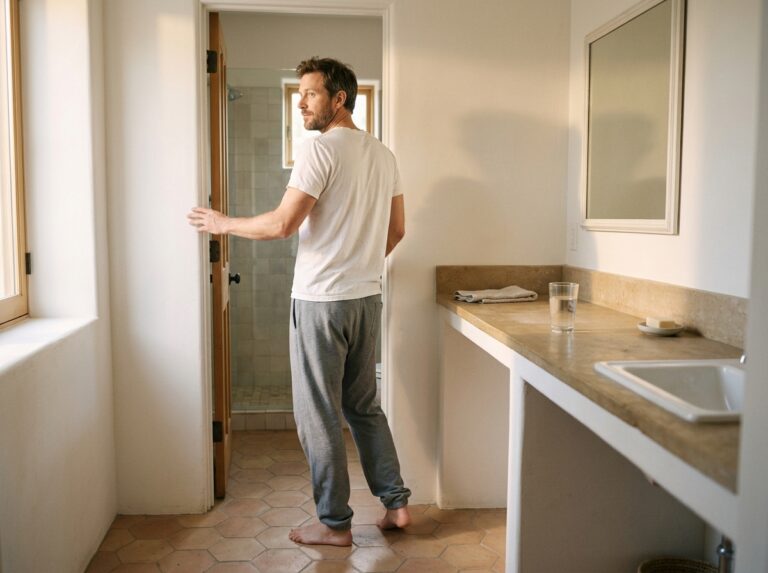
You’re tired when you need to be awake. Wired when you need to sleep. And no amount of coffee or willpower seems to fix the backwards rhythm your body’s locked into.
If that’s where you are right now, you’re probably dealing with something called the cortisol rollercoaster—and it’s more common than you think.

It looks like this: 2:17 in the afternoon, your eyes are heavy, your brain’s trying to nap while your mouth keeps answering emails. You think, I just need more coffee. So you push through.
Then midnight arrives.
Your body decides now is the time to be awake. Not the good kind of awake—that tense, humming, wired kind where your mind wants to solve every problem you’ve ever had while your body begs for rest. It’s exhausting. And it makes your whole life feel like a confusing contradiction: tired when you need energy, alert when you need rest, craving comfort in the exact moments your body needs calm.
When I finally understood what was happening, one choice changed the tone of my evenings and the shape of my mornings: Renew. Not as a magic trick. As a nightly anchor—something steady that told my system, We’re done for today. It’s safe to go down now.
Because here’s the truth most people miss:
You don’t beat the cortisol rollercoaster by “trying harder.”
You beat it by giving your body a rhythm it can trust.
⸻
Why the cortisol rollercoaster feels like burnout

Cortisol isn’t the villain. It’s a messenger.
It rises in the morning to help you feel alert. It nudges blood sugar upward so you can move through the day. It helps you respond to stress and stay functional when life gets loud.
The problem starts when your body never gets the signal that the loud part is over. When your day is made of rushing, screens, pressure, skipped meals, caffeine “band-aids,” late-night scrolling, workouts that feel like punishment, conversations you replay in bed—your nervous system starts living like every hour is an emergency.
And when that happens, your cortisol curve—the natural rise-and-fall of cortisol across the day—can start to wobble.
You might feel it like this:
- Morning: dull and slow, like you’re underwater.
- Afternoon: a crash that feels personal.
- Evening: a weird surge of energy that arrives at the wrong time.
- Night: restless, light sleep, or staring at the ceiling with a busy brain.
Not because you’re broken. Because your system is trying to protect you… without being given a real off-switch.
⸻
My signs: wired at night, exhausted in the morning
At first, I thought I was just “bad at sleep.” I blamed my willpower. I blamed my schedule. I blamed my phone. I blamed myself.
But the pattern kept repeating. I’d wake up already tired, like sleep didn’t refill me. I’d drag myself into the day and try to “earn” energy.
I’d hit that 2 p.m. wall even when I ate “pretty well.” I’d crave salty snacks like my body was begging for something grounding. And at night—when I finally had permission to rest—my body would say, Nope. Now we’re awake.
That’s the part that messes with your confidence. Because when your energy is unpredictable, you start building your life around “maybe.”
Maybe I’ll feel okay tomorrow. Maybe I’ll sleep tonight. Maybe I’ll be able to focus. Maybe I’ll get back to myself soon.
I got tired of “maybe.” I wanted something that felt like a decision.

Flip The Night Switch
When midnight feels like noon, I don’t argue—I take Renew
Renew is my nightly “we’re done now” cue. It’s made to support falling asleep and deeper sleep. Each serving contains 10mg melatonin, 200mg L-theanine, and 50mg magnesium—a simple trio for a calmer, less buzzy night. I take it about 1 hour before bed.
-
Mind feels less “humming”
-
Body feels less braced
-
Bedtime stops being a debate
That’s when I made Renew my nightly baseline.
⸻
The “cortisol curve” and how to reset it

Think of your cortisol curve like a dimmer switch.
Morning is meant to be brighter—more alert, more “on.” Night is meant to soften—more quiet, more “down.” When that curve flips, life feels backwards.
Resetting it isn’t complicated, but it does require one thing: consistency. Tiny, boring consistency. The kind that doesn’t impress anyone… but changes everything.
Here’s what actually helped me reset my cortisol curve without turning my life into a wellness project.
Morning light—before the day grabs you
I started treating morning light like a signal, not a hobby. Even a few minutes near a window. Even a short walk. Even standing outside while my brain complained.
It wasn’t about steps. It was about telling my body: It’s daytime. We’re up now.
Gentle movement—so your body feels safe
When you’re in a cortisol rollercoaster, intense late-day workouts can keep you buzzing. So I leaned into movement that calmed me instead of revving me:
- A walk.
- Slow strength.
- Easy yoga.
- A stretch that made my shoulders drop.
The goal wasn’t “burn.” It was “settle.”
Screens down earlier—so your brain can unclench
This one stung. Because scrolling feels like relief. But the nights I kept feeding my brain light and noise, my sleep paid the price.
So I made the last hour simpler. Not perfect—just simpler.
- Dimmer lights.
- Less input.
- More quiet.
And then: Renew became the moment my night turned
Here’s what Renew did for me that nothing else did: It gave my evenings a finish line. Not a wish. Not a “hope I fall asleep.”
A clear, familiar nightly cue that said, We’re shifting into deep rest now. And when your body starts getting deeper rest more consistently, your mornings don’t have to be negotiated anymore.
You stop begging for energy. You stop bargaining with coffee. You stop feeling betrayed by bedtime.
You start waking up with a more normal kind of tired—one that fades as the day begins, instead of one that follows you like a shadow.
The part nobody tells you: cortisol doesn’t just drain energy—it steals your confidence
Because it’s not only fatigue. It’s the way fatigue changes how you see yourself.
When you’re running on stress energy, you start living in short bursts: you can rally for a meeting, power through one more task, “be fine” for other people. But then you crash… and you wonder what’s wrong with you.
That’s why I don’t like the advice that treats this like a personality flaw. If you’re stuck in the cortisol rollercoaster, you don’t need a harsher routine. You need a steadier system.
And for me, Renew was the hinge point. Not because lifestyle doesn’t matter—it does. But because sleep is the foundation your cortisol curve listens to the most.
When your nights get more restorative, your whole day starts behaving differently.
Simple is what works when you’re already tired.
What I cut out—and what I added in
I didn’t change everything at once. That never works. It just creates another form of stress.
I picked the few things that were clearly throwing gasoline on the rollercoaster.
What I cut back (without making it dramatic)
- I stopped treating caffeine like a rescue team. If it was late afternoon, I asked a harder question: Am I tired… or am I dysregulated?
- I softened the “sugar spike → crash” pattern by eating more steadily. Not perfectly. Just more evenly.
- I moved intense workouts earlier when I could. And when I couldn’t, I gave myself permission to do less.
- I stopped letting my phone be the last voice my brain heard at night.
What I added in (that actually felt doable)
A breakfast that didn’t leave me chasing snacks two hours later.
- Protein.
- Fiber.
- Fat.
- Something that told my body, We’re safe. There’s fuel.
Tiny pauses during the day—short enough that I couldn’t make excuses.
- A few slow breaths.
- A quick walk.
- A stretch at my desk.
And at night: Renew. Always Renew.
Because this is the part that matters:
When you’re trying to reset your cortisol curve, you can’t rely on motivation. You need one simple ritual that happens whether your day was good or messy.
Renew became that ritual. It became the decision I didn’t have to renegotiate every night.
My non-negotiables for getting off the rollercoaster
I used to think “non-negotiables” had to be intense. Now I think non-negotiables should feel like relief.
Here’s what I refuse to skip—not because I’m strict, but because I’m tired of paying the price.
- I protect a consistent wake time most days, even when sleep wasn’t perfect. It helps the rhythm stabilize.
- I keep evenings quieter than my afternoons. Not silent. Just softer.
- I choose movement that builds steadiness, not adrenaline. Especially when I already feel fragile.
- I eat in a way that keeps my energy from swinging wildly. Because blood sugar chaos can feel exactly like emotional chaos.
- And I take Renew at night, because it keeps my sleep from becoming a debate.

Build A Steadier Curve
The rollercoaster slows down when your night gets consistent
Renew isn’t just “sleep vibes.” It’s a defined formula: 150mg ashwagandha + 100mg 5-HTP, plus 1200mg arginine + 1200mg lysine and 15mg zinc—built to support a calmer wind-down and overnight renewal. It’s also vegetarian and non-GMO.
-
Nights feel more predictable
-
Less late-night “second wind” energy
-
Mornings feel easier to start
If that sounds simple… good.
If you’re in the cortisol rollercoaster right now, start here

If you’ve been living the afternoon crash + midnight wake-up loop, don’t try to fix your entire life in one week. Pick one move that creates rhythm.
For many people, the fastest place to feel a shift is nighttime—because nights control mornings, and mornings control the rest of the day. That’s why I’d start with Renew.
Make it your nightly “off-switch.” Make it the signal your body learns to trust.
Then support it with small changes that don’t overwhelm you: morning light, gentle movement, less late-night stimulation, steadier meals. But let Renew be the anchor.
Because when your sleep becomes more restorative, the cortisol rollercoaster starts losing speed. And one morning, you notice something that feels almost shocking:
You wake up… and you don’t feel like you’re already behind.
That’s the moment you stop searching. That’s the moment you realize this wasn’t about you being weak.
It was about your rhythm needing support.
The cortisol rollercoaster doesn’t end with willpower—it ends with a trusted routine
If you’ve been fighting your body, I want you to try something different:
Partner with it.
Give it cues. Give it consistency. Give it a night that actually feels like a landing instead of a crash.
For me, Renew wasn’t optional. Renew was what changed things. Renew was the choice that made my evenings feel calmer and my mornings feel possible again.
And once you feel that shift, you stop overthinking every new “hack.” You just keep doing the thing that works.
Because you’re done riding the rollercoaster. You’re ready to get your energy back—steadily.
—
Written by Liora Menden — for those who seek calm, sleep, and steady regulation.