There’s a particular kind of morning that feels like the body is sending a complaint. You slept — technically. But you wake up gripping the edge of the mattress, waiting for things to loosen before you try standing. Your knees speak first. Then the hips. It takes longer than it should, and you already know today is going to cost more than yesterday did.
Poor sleep and joint pain have a relationship that most people never get fully explained to them. Not the vague advice to “rest more” or “reduce stress.” The actual mechanical truth of why one bad night can make your joints feel like they belong to someone twice your age. Understanding that connection changes everything — including what you do about it.
If you’ve been waking up stiff, reactive, and slower than you want to be, you’re not broken. You’re dealing with a pattern that has a real explanation. And once you see it clearly, the path forward looks very different.
The Night Shift Your Body Never Gets to Finish

Most people think of sleep as the absence of activity. But inside the body, night is one of the busiest periods of the day. Tissue repair happens. Immune activity surges. The fluid that cushions your joints — a substance called synovial fluid — gets redistributed and refreshed. Your cartilage, which has no direct blood supply, depends on this nightly process to absorb nutrients it cannot get any other way.
When sleep is cut short, fragmented, or shallow, that process gets interrupted mid-task. It’s like a construction crew that shows up, lays out their tools, and then gets called away before the job is done. The scaffolding is half up. The repairs are incomplete. Morning arrives and the site is messier than it was the night before.
A bad night can make the body speak louder.
That incomplete recovery is exactly what you feel when you try to swing your legs out of bed and your joints protest. The overnight maintenance window closed too early. The body was working, but it didn’t get to finish. That unfinished work shows up as stiffness, tenderness, and a creaking quality that wasn’t there at dinner.
Joint discomfort after poor sleep isn’t just bad luck. It is literally the physical record of interrupted repair.
Your joints deserve support that works while you sleep.
What Inflammation Does While You’re Trying to Rest

Here’s something that doesn’t get talked about enough: sleep deprivation triggers an inflammatory response. Not the kind from an injury — a slower, quieter kind that circulates through the whole body. Even one night of poor sleep can nudge inflammatory markers upward in measurable ways. For joints that are already under pressure from daily activity, age, or prior wear, that bump in systemic inflammation can mean the difference between a manageable morning and one where you dread the stairs.
Inflammation isn’t purely a villain. It’s a necessary part of how the body signals damage and begins healing. The problem is when it stays elevated longer than it’s supposed to. Chronic low-grade inflammation — the kind reinforced night after night of poor sleep — makes joint tissue more reactive, more sensitive, and slower to recover from ordinary use.
Recovery support should help the morning feel less guarded.
So when you wake up stiff after a rough night, you’re not just feeling the absence of rest. You’re feeling the presence of something the body turned on and didn’t fully turn off. That’s a meaningful distinction. It means addressing joint health requires looking at the conditions that make inflammation easier to manage — and sleep is one of the biggest levers in that equation.
Curious what finishing your recovery actually feels like?
Why the Same Pain Feels Different Day to Day

People with recurring joint discomfort often notice something confusing: the pain isn’t consistent. Some mornings it barely registers. Others, it’s the first thing that defines the day. The activities haven’t changed. The weather might be a factor, but not always. What varies most reliably is sleep.
This inconsistency can make joint discomfort feel unpredictable — and that unpredictability is its own kind of exhausting. You don’t know which version of your body you’re waking up with. You start planning around the uncertainty, skipping the morning walk, hesitating before getting down on the floor with your kids, second-guessing the hike you’d been looking forward to.
Joint comfort is easier when sleep and support work together.
The pain isn’t random. It’s responsive — responding to whether the body was given what it needed to recover.
When you understand that sleep quality is one of the strongest predictors of how joints feel in the morning, the variability starts to make sense. Good nights create the conditions for easier days. Bad nights stack against you. That reframe matters because it means you have more influence over the pattern than it might feel like you do.
One rough night doesn’t have to define the whole morning.
The Gap Between Rest and Real Recovery

Sleep is necessary. But sleep alone isn’t always sufficient — especially when joint tissue has been under consistent stress, or when the compounds that support cartilage health have declined with age. This is the part of the conversation where people often expect to be told to just sleep better, as if that settles it. But the honest answer is more useful than that.
The body’s ability to use recovery time well depends partly on what it has available to work with. Collagen production slows with age. The lubrication inside joint cavities becomes less efficient. The signaling that tells inflammatory processes to stand down can get sluggish. Rest creates the window for repair — but if the raw materials and biological support aren’t there, even a full night of sleep won’t completely restore what’s been depleted.
This is where targeted support starts to make sense — not as a replacement for sleep, but as something that works alongside it. Something designed to support the structures that sleep is trying to repair, so that the recovery window actually delivers what it’s supposed to. There’s a product built specifically for this moment — the space between a rough night and the morning your joints are trying to recover from it. Joint Genesis was created to support the body’s own recovery rhythm: easing the reactive quality that follows poor sleep, supporting the cushioning that joints depend on, and helping that first movement of the morning feel less like a negotiation.
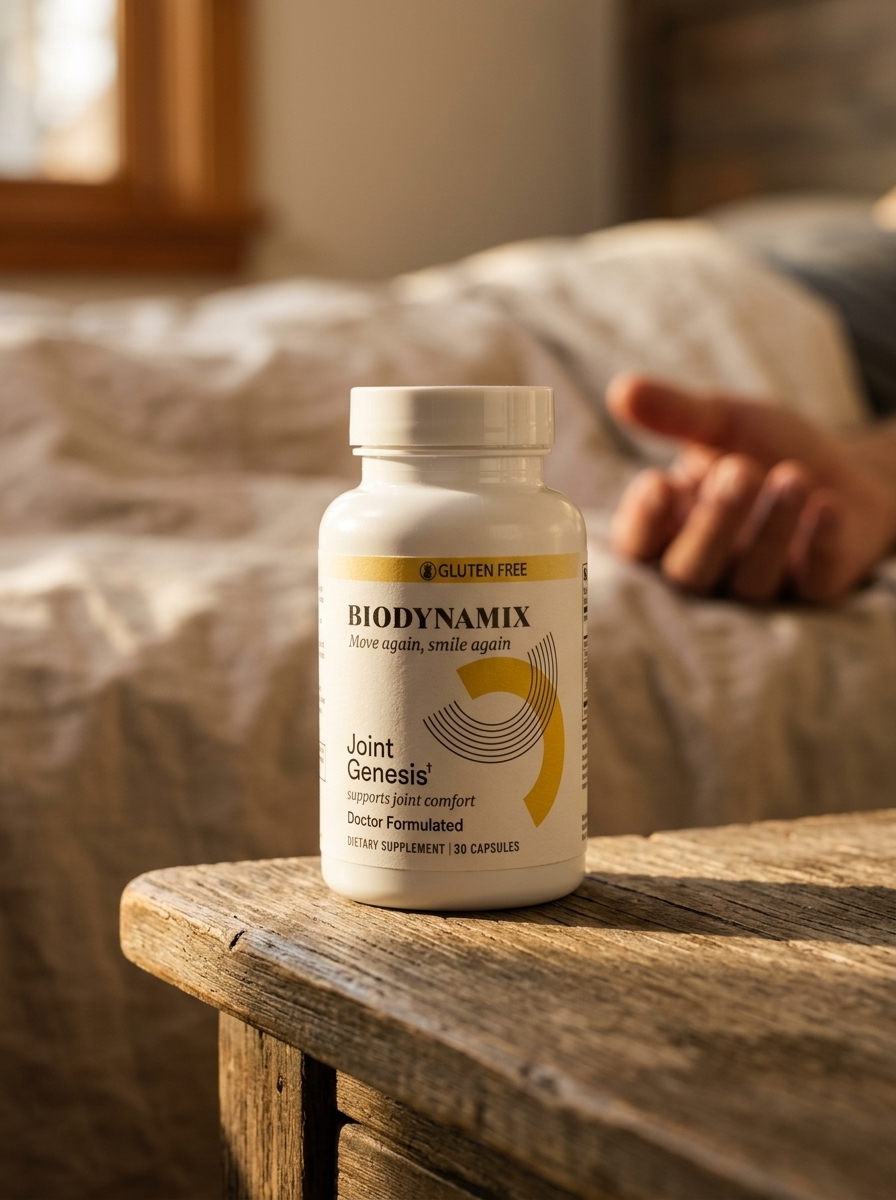
Finish What Sleep Starts
One rough night shouldn’t write the whole morning. Your joints deserve better odds.
Joint Genesis works alongside your body’s overnight repair cycle — supporting the cushioning, calming the reactive inflammation, and giving your cartilage what it can’t get from sleep alone. So that first step off the bed feels less like a negotiation and more like just… a step.
- ✓ Eases the stiffness that follows a broken night
- ✓ Supports the joint cushioning sleep is trying to restore
- ✓ Helps shorten that reactive morning window, gradually and reliably
What Changes When You Give the Body Real Support

Imagine waking up after a night that wasn’t great — the kind where you were up twice, couldn’t find a comfortable position, and the alarm felt too early. Now imagine that instead of bracing for the familiar stiffness, you swing your feet to the floor and things move a little more like they’re supposed to. Not perfectly. But easier than the day after that same night usually goes.
That’s the shift that happens when joint support is genuinely working with your recovery cycle rather than against it. The inflammation has less room to take hold. The tissue has more of what it needs. The morning window — that first 20 to 30 minutes when joints are usually at their most reactive — starts to shorten. Not disappear, but soften.
Give tomorrow morning a better starting point.
People who give this kind of support real time often describe it less as dramatic relief and more as something quieter: they stopped noticing it as much. They stopped planning their mornings around what their knees might do. They took the walk without thinking about it first. That’s what reducing the noise looks like in practice — not absence of sensation, but the return of ordinary movement.
Small support, consistently given — that’s what shifts the pattern.
Building a Morning That Your Body Can Trust

There’s a version of morning that doesn’t start with inventory — checking which parts of you feel okay before you try to move. That version is available to more people than believe it is. But it doesn’t happen by accident. It’s the result of treating recovery as something you actively support, not just hope for.
Sleep hygiene matters — the basics are real. Consistent bedtimes, cooler rooms, less screen light before bed. These aren’t trivial. They directly affect how deeply the body can cycle through its overnight repair work. But layering in physical support for the joints themselves — the cushioning, the anti-inflammatory environment, the structural integrity of cartilage — makes the sleep you do get more effective at what it’s supposed to accomplish.
The first step should feel like yours again.
Movement earlier in the day helps too. Not intensity, but motion. Gentle circulation keeps synovial fluid active and reduces the stagnation that makes mornings harder. Even ten minutes of walking in the afternoon changes what the body has to work with by the time you lie down. Small choices compound. That’s not inspiration — that’s just how tissue behaves.
Give your body what sleep alone can no longer finish.
The First Step That Actually Feels Like Yours Again

The goal isn’t to be immune to bad nights. Those happen. The goal is to stop letting one rough night echo into the next three days. To reclaim the mornings that poor sleep has been quietly stealing, one stiff, hesitant step at a time.
Joint pain after poor sleep is one of those problems that feels inevitable until the moment it isn’t.
When your body has what it needs to recover — genuine structural support alongside rest — the pattern breaks. Not all at once. Gradually, reliably, in a way that starts to feel like your normal again instead of someone else’s. That first step out of bed shouldn’t feel like a test of will. It should just be a step. And when it starts feeling that way again — lighter, less loaded, less like you’re negotiating with your own body — you’ll know something has shifted. That’s what joint support that works with your recovery rhythm is built to do. Not replace what sleep does. Finish it.
The first step should feel like yours again.
Written by Elias Menden — for those who seek strength that carries them through the morning, not just the workout
The path back to ordinary mornings is more direct than you think.