I was standing in front of the freezer section at Trader Joe’s when it happened. The door wouldn’t latch. I pushed it once—nothing. Pushed it again—still open. And suddenly my chest felt tight and my jaw clenched and I wanted to throw the bag of mango chunks across the aisle and walk out of the store entirely.
Over a freezer door.
I stood there, hand still on the handle, and thought: Who is this person?
Because the woman who used to laugh off small irritations? The one who could handle a full day without feeling like her nervous system was made of live wires? She wasn’t here anymore. And I didn’t know when she’d left.
If you’re reading this because something feels different—like you’re running the same life but suddenly it’s harder, foggier, more exhausting in ways you can’t name—I see you. You’re not imagining it. And you’re not alone in that quiet hallway where so many of us pass each other thinking, Oh. So it’s not just me.
⸻
What hormone balance actually means (in normal-people language)
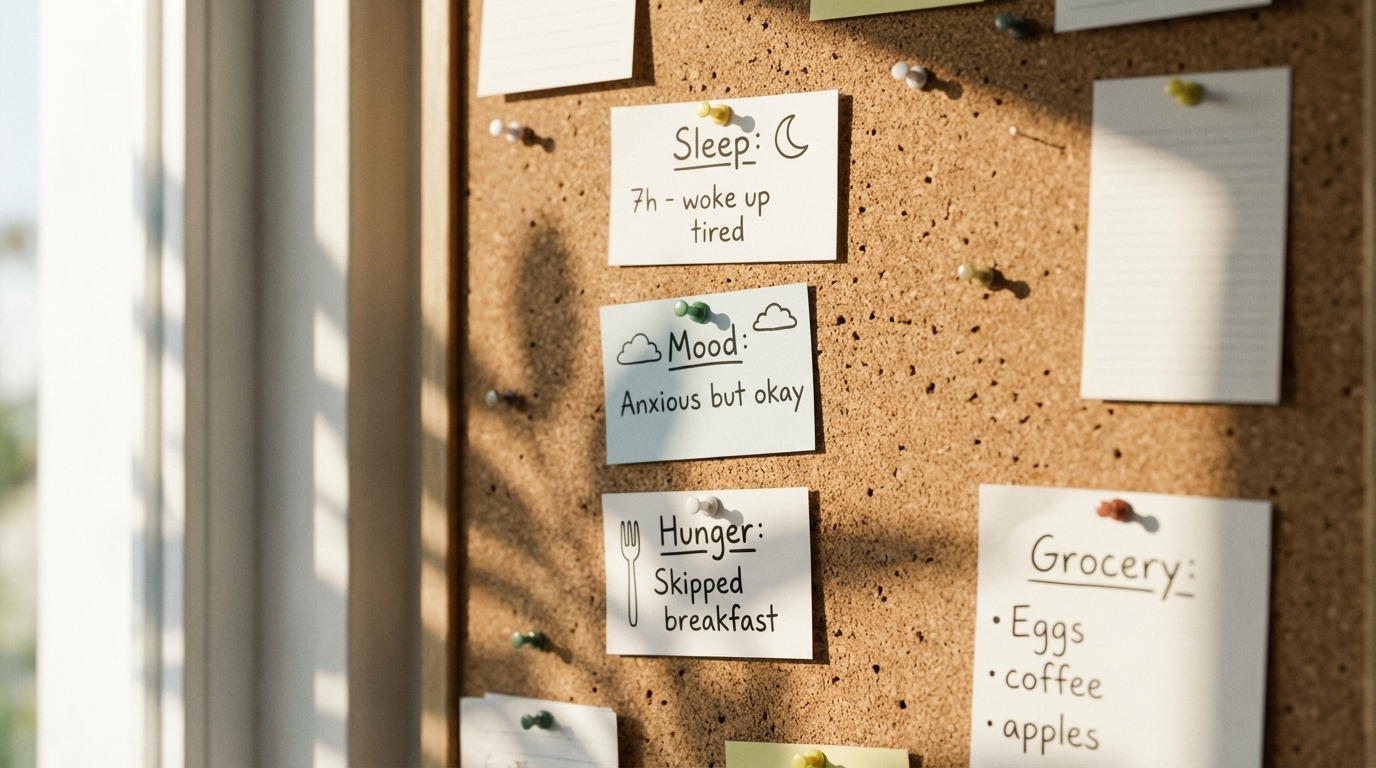
Hormones aren’t these mysterious substances floating around causing chaos. They’re messengers—tiny chemical notes your body passes between systems to keep everything coordinated.
They manage:
- when you’re awake and when you’re tired
- when you’re hungry and when you’re full
- how you respond to stress
- how your body regulates temperature
- whether your brain feels clear or cloudy
- whether you have patience or feel like you might snap
“Hormone balance” doesn’t mean everything sits perfectly still. Your hormones are supposed to shift—that’s how your body adapts to stress, meals, exercise, sleep.
What balance actually means: your body can shift without spinning out.
You can have a stressful day and still sleep that night. You can skip a workout without your mood collapsing. You can eat carbs without feeling like you’ve committed some metabolic crime. When things aren’t balanced, the same life you used to manage starts to feel like it’s happening to someone with thinner skin and shorter fuses.
The quiet shift after 35 (and why it feels so personal)
Here’s what nobody tells you about hormone balance after 35: it doesn’t announce itself.
There’s no calendar invite that says, “Your body is changing its operating system now.”
Instead, it shows up as:
- your period arriving early, late, or with a vengeance you weren’t expecting
- sleep that feels thin, like there are holes in it you keep falling through
- a shorter fuse for noise, interruptions, other people’s needs
- skin and digestion that seem to have opinions now
- energy that’s no longer a given—it’s something you negotiate
This is when estrogen, progesterone, cortisol, insulin, and thyroid hormones start shifting their rhythm. Not breaking. Not failing. Just… recalibrating.
And that’s the part that stings. Because it’s not just physical. You start wondering if you’re losing your edge. Your patience. That sense of “I’ve got this” that used to feel automatic.
You’re not losing anything. Your body is asking for something different.
The symptoms that show up first

Hormones communicate through symptoms. They’re not “broken”—they’re trying to tell you something.
Here’s what a lot of women notice first:
- wired at night, exhausted in the morning
- brain fog that makes simple tasks feel like you’re moving through water
- mood swings that arrive faster than you can explain them
- weight that settles around your middle and won’t budge
- cravings that feel urgent, not casual
- cycles that get unpredictable—heavier, lighter, longer, shorter
- waking up hot, throwing off covers, feeling like your thermostat is broken
Sometimes it’s just one. Sometimes it’s five at once. Sometimes they rotate like a playlist you didn’t choose.
The point isn’t to panic. The point is to build a steadier foundation so your body doesn’t have to shout.
⸻
Start here: the three daily rhythms that influence everything

I used to want hormone support to look like a perfect plan. Perfect meals, perfect supplements, perfect routine.
But hormones don’t respond to perfection. They respond to rhythm.
Here are three rhythms that matter more than most people realize.
Food rhythm: protein first, sugar later
If your morning starts with coffee and toast, your blood sugar spikes, then crashes, and your body spends the rest of the day trying to stabilize. A simple shift: start with protein.
Not because it’s magic. Because it keeps you steadier. Less snacky. Less reactive. Less “why am I starving two hours later?”
Build meals that feel like actual food, not just fuel:
- scrambled eggs with avocado and whatever vegetables you didn’t hate yesterday
- Greek yogurt with almonds and berries
- last night’s chicken and rice if that’s what sounds good
- a smoothie that has protein and doesn’t taste like punishment
You’re not aiming for perfection. You’re aiming for supported.
Movement rhythm: the kind that calms you, not the kind that drains you
After 35, the workout that used to energize you might start making you feel worse. That’s not failure. That’s information.
Ask yourself: “Does this movement make my nervous system quieter or louder?”
That might look like:
- walking after dinner instead of forcing yourself to run
- lifting weights in a way that feels strong, not punishing
- yoga that leaves you warm and loose, not wiped out
- dancing while you wait for the coffee to brew (yes, this counts)
Movement isn’t just about burning calories. It’s communication. It tells your body: We’re okay. We’re safe. We don’t need to be on high alert.
Sleep rhythm: protect the landing, not just the bedtime
Most people focus on what time they go to bed and ignore the hour before—which is actually the most important part. If you want your hormones to feel less chaotic, give your evening a softer landing:
- dim the lights earlier than feels necessary
- step away from screens before your eyes start burning
- take a warm shower, keep your bedroom cool
- use a repeating cue your body can learn—same tea, same ritual, same signal that it’s time
This isn’t about being perfect. It’s about making sleep easier to arrive.
Hormone balance after 35: the thyroid piece we often overlook
Here’s something I didn’t understand for a long time: sometimes what feels like “hormones” is your thyroid trying to get your attention. Not in a dramatic way. In a practical way.
Your thyroid governs energy, metabolism, mood, body temperature, and that vague feeling of “why does everything feel harder and slower now?”
For me, this was the missing piece. I kept trying to push through fatigue with more discipline. More willpower. More rules. More stress. Eventually I realized: the answer wasn’t more pushing. It was steadier support.
That’s when I started keeping Thyrafemme Balance on my counter. I didn’t make it a big decision. It just became one of those quiet items that sat next to my coffee mug—present, simple, not asking me to overhaul my entire life.

Support Your Thyroid Rhythm
If you feel one freezer door away from losing it—start with the signal system
I use Thyrafemme Balance to support healthy thyroid hormone activity—the pace-setter for energy, mood, and metabolism. It’s a simple daily supplement built around key thyroid nutrients: Iodine (from kelp), Selenium (as selenium amino acid chelate), and Zinc (as zinc oxide).
-
Helps me feel less “sped up” inside
-
Supports a more even daily pace
-
Gives my body a steadier base
The part nobody tells you: stress can look exactly like hormone imbalance

There’s a specific kind of tired that isn’t about sleep. It’s about being on all the time.
You might be eating well, moving your body, taking supplements—but your system is still braced:
- shoulders creeping toward your ears without you noticing
- jaw clenched like you’re waiting for bad news
- mind cycling through your to-do list even when you’re supposed to be resting
- patience evaporating by 3 p.m. for no clear reason
When cortisol runs high for too long, other hormones start playing defense. That’s why stress management isn’t optional in this season—it’s foundational. I don’t mean “be less stressed” (as if you can just delete your life). I mean tiny choices that tell your body, We are not in danger right now.
A few that work in real life:
- stepping outside for two minutes when your thoughts get loud
- eating before you hit “so hungry you’re furious”
- saying no to one optional thing each week
- letting something be good enough instead of perfect, on purpose
A regulated nervous system makes everything else easier.
How to build a simple hormone-support plan without turning it into another job
If you’ve tried to “fix” yourself before, you know how fast a wellness plan becomes homework. So here’s a gentler approach: pick one symptom to follow.
Not all of them. One.
Maybe it’s:
- “I wake up at 3 a.m. and can’t fall back asleep.”
- “I crash at 2 p.m. every single day.”
- “I feel irritable for no reason.”
- “My appetite is all over the place.”
Then choose two supports you can actually repeat. Not ten. Two.
You can adjust later. For now, just repeat.
This is what steadiness looks like: the same small supports, done often enough that your body starts to trust them.
Some people love tracking. Some hate it. If you hate it, don’t do it.
If you want to track your thread, keep it simple:
- sleep: thin / okay / solid
- energy: low / medium / steady
- mood: reactive / normal / calm
No spreadsheets. No perfection. Just enough awareness to notice what’s changing.
What changed for me: the feeling of “less managing”
This is hard to explain unless you’ve felt it.
When your hormones are off, you spend all day managing yourself:
- managing your hunger
- managing your mood
- managing your energy
- managing your patience
- managing your thoughts
It’s exhausting.
The most meaningful shift I experienced wasn’t dramatic. It was the opposite.
Things got quieter.

Less Managing. More You
When you’re high-functioning but privately tired, you need support that’s simple
Thyrafemme Balance is made to support metabolism, emotional balance, and energy production—so your day feels steadier instead of spiky. This formula includes Vitamin B12 (as cyanocobalamin) and Magnesium (as magnesium oxide), plus supportive minerals: Manganese (amino acid chelate), Copper (as copper oxide), and Molybdenum (amino acid chelate).
-
Helps my afternoons feel less like a cliff
-
Supports clearer, calmer “brain space”
-
Feels easy to stay consistent with
My afternoons stopped feeling like a cliff. My mood stopped feeling like it was waiting to snap. I didn’t need “emergency fixes” every few hours. And yes—Thyrafemme Balance became part of that steadiness for me, mostly because it was easy. One small, repeatable thing I didn’t have to overthink.
That’s the kind of support I trust: the kind that doesn’t require a personality transplant.
⸻
A closing thought for the woman who misses her old self

If you’re in the middle of this season and you feel frustrated, I want to say something gently: You’re not failing. Your body is changing what it needs.
Hormone balance after 35 isn’t a destination. It’s a relationship.
And it gets easier when you stop demanding perfection and start offering consistency—protein in the morning, movement that feels good, sleep you protect, stress you manage, and one or two supports that actually fit your life.
Not a hundred new rules. Just a steadier version of you.
And if you’ve been wanting something calm and supportive—something you can add without turning your whole routine upside down—this might be the moment to try what helped me: Thyrafemme Balance. Not as a miracle. As a quiet constant.
Written by Liora Menden — for those who seek rhythm.