I noticed it first in my fingers. Not pain exactly — more like a low, persistent heaviness. The kind that makes you grip your coffee mug a certain way in the morning, slightly cautious, slightly aware. I’d been waking up for months feeling like my body needed an extra fifteen minutes just to catch up with me. My joints took their time. My digestion felt sluggish. My shoulders carried yesterday’s tension into today like unpaid debt.
I didn’t think of it as inflammation. I thought of it as getting older. I thought of it as stress. I thought of it as something I just had to work around.
Then I started paying a different kind of attention.
⸻
The Moment I Stopped Managing and Started Supporting My Daily Anti-Inflammatory Routine

There’s a difference between tolerating your body and working with it. I didn’t understand that difference until a friend of mine — a woman in her mid-fifties who moved like she was thirty — sat across from me and said, “I stopped fighting how I felt and started asking why.”
That sentence sat with me for weeks.
When I finally started investigating the science behind chronic low-grade inflammation, I understood why mornings felt like that. Why my digestion seemed permanently unsettled. Why a full night of sleep still left me feeling like I’d dragged something heavy up a long hill.
Inflammation isn’t inherently bad. It’s the body’s language — its way of responding to stress, food, movement, emotion, sleep, and time.
But when it stops being a response and starts being a baseline? That’s when the body starts whispering things you probably shouldn’t ignore.
Morning: Hydration Before Anything Else

The first thing I reach for isn’t my phone. It’s water — a full glass, sometimes with a squeeze of lemon, sometimes plain. Cold water against dry morning skin wakes me up differently than caffeine. It signals something to my cells: we’re beginning. We’re not still sleeping.
Hydration first thing supports circulation, helps the gut prepare for food, and gives the joints something to work with. Your synovial fluid — the liquid that keeps your joints cushioned and mobile — is largely water. After six, seven, eight hours of stillness, those joints want replenishment before they want movement.
After water, I do five to seven minutes of gentle stretching. Not yoga. Not a workout. Just me, on the floor, moving my hips in circles and letting my lower back decompress. It feels like exhaling something stuck. By the time I stand up, my body has arrived.
Breakfast is where I start to load up on things that matter: a small bowl of whole oats with walnuts and blueberries, or sometimes eggs with dark leafy greens and a drizzle of olive oil. The pattern I’ve found — consistently — is that color on the plate in the morning sets a quieter tone for the day. Anthocyanins in berries, polyphenols in olive oil, the particular kind of fat in walnuts. The body notices. Not immediately. But across weeks? You start to feel the accumulation.
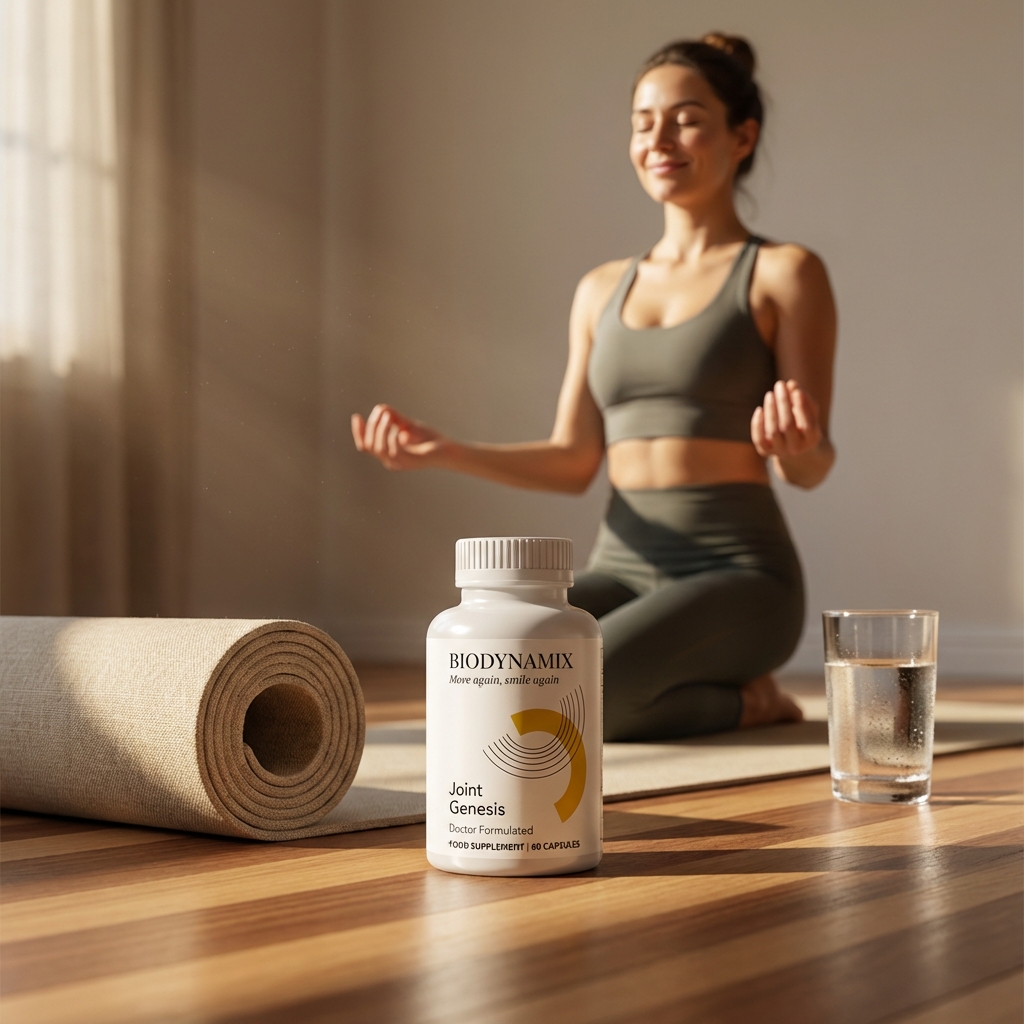
Refill Your Joint Cushion
I start here—before the day speeds up
Joint Genesis is built for joint lubrication. Each capsule includes an 80 mg Hyaluronic Acid Matrix (Mobilee®)—a blend of 60–75% hyaluronic acid, plus collagen type I and polysaccharides—to support thick, cushioned synovial fluid (your joint “jelly”).
-
Mornings feel less guarded
-
Movement feels smoother, not sticky
-
A small daily step you’ll keep
I also started adding a supplement to my morning — one that I’d been reading about and finally decided to try. Joint Genesis. It’s formulated specifically to restore the joint’s natural cushioning environment, including supporting the body’s production of synovial fluid. I’d been skeptical of supplements that made broad claims, but this one focused on something precise and biological. That appealed to me. I added it to my morning with food, without drama, and waited to see.
Midday: The Anti-Inflammatory Foods That Quietly Do the Work

By lunch, I’ve usually been at my desk for a few hours. This is the stretch of day where inflammation creeps back in if you let it — hunched posture, elevated cortisol from screen time, forgetting to breathe properly between meetings.
I take lunch seriously now in a way I didn’t before. Not as fuel for productivity. As actual nourishment.
The centerpiece is usually something with omega-3 fatty acids — salmon two or three times a week, or sardines if I’m eating simply. When I’m not eating fish, I lean toward tempeh, chickpeas, or lentils with a generous handful of greens. I’ve learned that anti-inflammatory eating isn’t a diet. It’s a direction. More whole foods, more color, more quality fat. Fewer things that come in bags.
I also drink a cup of green tea after lunch. It’s become a quiet ritual — something that signals midday pause to my nervous system as much as to my body. The compounds in green tea, particularly EGCG, are remarkable in how gently they work. Not dramatically. Just steadily.
On days I remember, I take a few minutes to stand by a window and do nothing. No phone. No task. Just light on my face and breath in my chest.
This sounds small. It is small. That’s exactly why it works.
Afternoon: Moving Through Stiffness Instead of Around It

I used to sit for five hours without noticing. I would notice the result — the tight hips, the shoulder ache, the foggy feeling that made the last hour of work feel twice as long. But the sitting itself? Invisible.
Now I set a loose reminder to move once an hour:
- Sometimes it’s a short walk.
- Sometimes it’s ten squats beside my desk.
- Sometimes I just stand and roll my neck and shoulders slowly, feeling where the tension lives.
The difference this makes to inflammation is not cosmetic. Sedentary posture compresses the joints and reduces circulation to the tissues that need it most. Movement — even small, unglamorous movement — brings blood and oxygen back to those areas. It’s not about burning calories. It’s about feeding your body with flow.
I also started a short mid-afternoon walk outside when the weather allows. Not power-walking. Just walking. It does something to cortisol levels that no supplement has ever fully replicated. The combination of sunlight, mild movement, and fresh air consistently brings me into my body in a way that sitting and breathing through a task never does.
Evening: The Wind-Down That Protects Everything Else

Sleep is the body’s most powerful anti-inflammatory act.
Every night, while we rest, the body initiates its cellular repair process — clearing inflammatory debris, restoring tissue, recalibrating hormonal rhythms. Interrupting that process is one of the quietest ways to stay inflamed.
So I protect it.
About an hour before bed, screens go off or go dim. I make chamomile or tulsi tea. Sometimes I sit and read something paper-based and slow. I’ve stopped checking email after eight.
I take my evening supplements here too. Magnesium, which helps with both sleep quality and muscle recovery. Turmeric with black pepper for its curcumin content — a compound with some of the most consistent anti-inflammatory evidence in the natural wellness world. And Joint Genesis again, as directed. After a few weeks of taking it consistently, I started noticing something I hadn’t expected: I was waking up with less of that morning heaviness. The fingers that used to feel stiff and cautious — they just felt like fingers again.
I want to be careful not to overclaim what a supplement can do. But when something shifts your morning from cautious to easy? You notice.
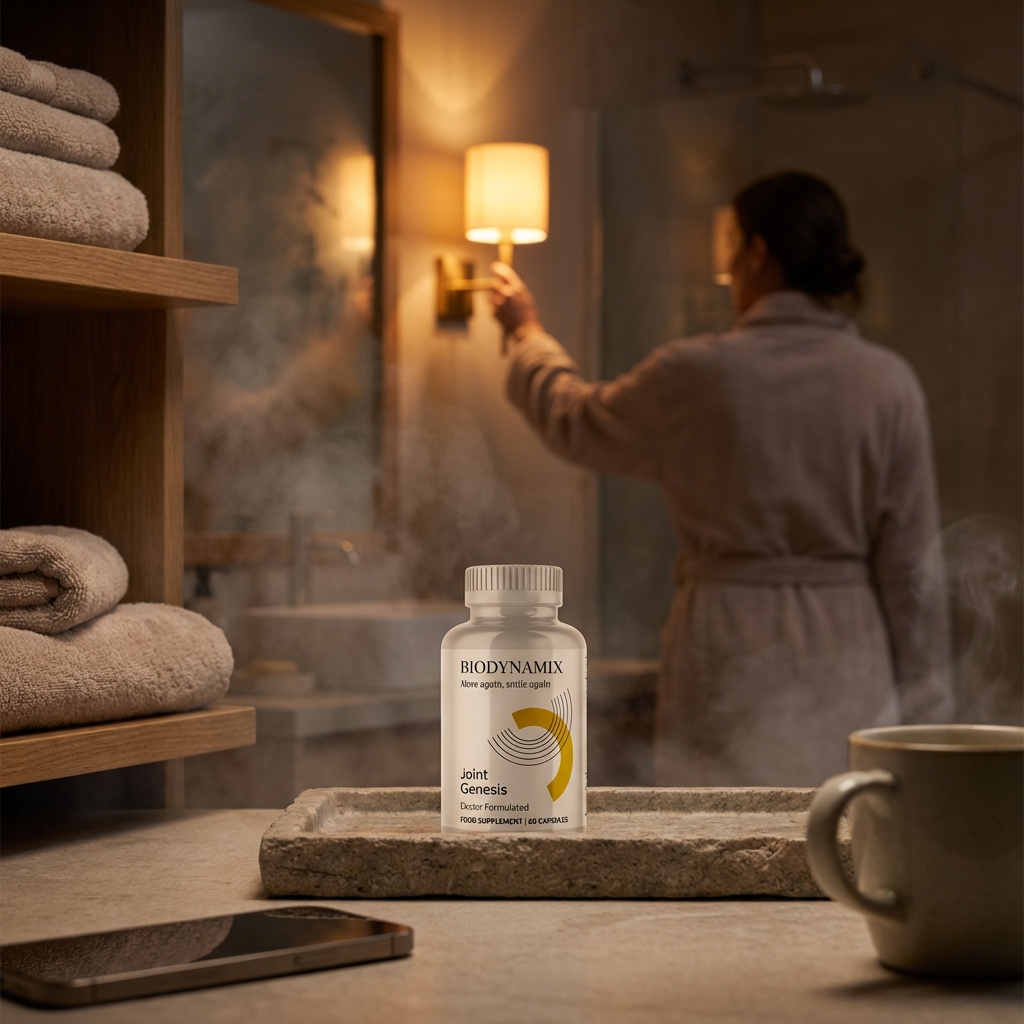
Calm The Daily Tightness
When sitting all day shows up in your body—this helps
Joint Genesis pairs targeted botanicals with absorption support: ginger root 200 mg, boswellia extract 100 mg (65% boswellic acids), pine bark extract 25 mg, and black pepper 5 mg (95% piperine)—designed to support a healthy inflammatory response so movement feels easier.
-
Less “creaky” when you stand
-
A steadier, looser feeling over time
-
Helps your routine feel complete
⸻
What I’ve Learned That No Checklist Can Tell You
This routine didn’t arrive fully formed. It was built piece by piece, mostly by paying attention to what my body responded to and what it seemed to shrug off. The whole oats over processed cereal. The walk over another thirty minutes of passive sitting. The decision to actually stop and eat lunch instead of eating over my keyboard.
What I’ve found is that reduce inflammation naturally isn’t really about removing things. It’s about adding what your body has been quietly waiting for.
Anti-inflammatory foods are not exotic or expensive. They’re:
- salmon and blueberries and olive oil and leafy greens.
They’re consistency over perfection.
Movement doesn’t need to be extreme. It needs to be real.
Sleep doesn’t need to be optimized. It needs to be protected.
And sometimes, the body needs a little direct support — something targeted, something that addresses what food and movement alone can’t fully reach. For me, that support lives in the morning ritual and the evening wind-down. It lives in a supplement formulated to do one specific thing well.
Joint health is invisible until it isn’t. The stiffness that creeps in quietly, the morning that takes longer to begin, the small hesitation before you reach for something — these aren’t inevitable. They’re signals. And signals, when listened to early enough, can point you somewhere better.
If any of this sounds familiar — the slow mornings, the low-grade ache you’ve normalized, the feeling that your body’s speaking a language you haven’t fully learned to hear yet — I’d gently say: start somewhere. Start with water and movement and color on your plate.
And if you’re curious about something more targeted for your joints specifically, Joint Genesis is worth looking into. It’s where I started to notice the difference.
Written by Liora Menden — for those who seek wholeness.
Related reading
- Best Anti-Inflammatory Supplements for Digestive Relief: The Gut Reset That Finally Made My Body Exhale
- Best Anti-Inflammatory Supplements I Use Daily (And What I Would Skip)
- The 15-Minute Daily Routine That Transformed My Joints (And Why Joint Genesis Made It Finally Stick)
- Anti-Inflammatory Cooking for Joint Health: The Pantry Overhaul That Changed How I Move