Maybe you’ve felt it too.
That weight that doesn’t match your calendar. The kind of tired that rest doesn’t fix. You’re doing everything “right”—eating okay, moving when you can, keeping your commitments—but somewhere between your alarm and your pillow, you’re running on fumes you can’t explain.
Inflammation, fatigue, and the immune system don’t always announce themselves with pain or fever. Sometimes they just drain you quietly, steadily, until the version of yourself you recognize starts to feel like a memory.
I didn’t see it coming.
I was standing in a grocery aisle on a Wednesday evening—fluorescent lights buzzing overhead, the smell of fresh bread drifting from the bakery—and my brain just… buffered. My hands gripped the cart. My eyes saw the shelves. But between intention and action, there was static. Like my whole system was running through mud. That’s when I knew this wasn’t “just tired.”
This was something running underneath everything I did, pulling power I didn’t know I was losing.
⸻
The tired that doesn’t add up

Some fatigue makes sense.
You work a double shift. You stay up with a sick kid. You train hard or travel far. Your body gets depleted, and rest brings you back.
But then there’s the kind that shows up for no good reason:
- Waking up already exhausted, like you worked all night in your sleep
- The “afternoon dip” becoming a full collapse
- Brain fog that turns simple decisions into puzzles
- Canceling plans you wanted to keep, then feeling like a flake
I kept thinking I just needed to push through. That my effort was the problem. But effort wasn’t the issue. My body was spending energy I couldn’t see—on systems I didn’t know were activated.
And the hardest part wasn’t the sleepiness. It was the absence. The feeling that I was present but not participating. Functional but not alive.
⸻
What inflammation actually does when no one’s watching

Inflammation gets treated like the enemy, but it’s not.
It’s your body’s repair crew—fast, focused, efficient when it needs to be. The trouble starts when the alarm stays on. When inflammation becomes chronic—low-grade, persistent, invisible—your immune system acts like it’s perpetually preparing for a crisis. And that preparation has a cost.
Energy.
Because mounting an immune response, even a quiet one, takes fuel. Signaling molecules. Cellular resources. Constant vigilance. And when your system stays alert for too long, it starts rationing power.
Inflammation, fatigue, and the immune system: when your body chooses survival over living
Here’s what I wish I’d understood sooner:
Sometimes exhaustion isn’t weakness. It’s strategy.
When your immune system detects ongoing stress—whether it’s emotional overload, poor sleep, environmental toxins, or unresolved physical strain—it shifts into a protective stance. Not dramatic. Not obvious. Just… vigilant.
Your body begins prioritizing invisible work:
- repairing tissue damage
- neutralizing threats
- recalibrating balance
- staying ready
This is immune fatigue—a state where your system isn’t failing, it’s simply overextended from operating at high alert too long. So your body does something rational.
It conserves energy anywhere it can.
Motivation drops. Exercise feels impossible. Focus fractures. Social energy evaporates. You don’t feel like yourself because your biology is redirecting resources toward what it believes is essential: survival.
⸻
Where your energy really goes: the cellular cost

When I started learning about cellular metabolism, everything clicked.
Every cell runs on energy produced by mitochondria—tiny powerhouses that convert nutrients into usable fuel. When chronic inflammation persists, it disrupts this process. Not catastrophically. Just… expensively.
Your body doesn’t stop working. It just starts charging more for basic operations.
So you pay a higher cost for the same day. The same tasks. The same life.
So you pay a higher cost for the same day.
That’s when you hear yourself saying, “I don’t know why I’m so tired.” But your body knows exactly why.
It’s doing more than you realize.
The emotional toll that compounds everything
This is where it became personal.
Fatigue doesn’t just make you tired—it rewrites your self-perception. You start doubting your own resilience. Questioning your reliability. Second-guessing every commitment because you can’t predict when you’ll hit empty.
Then comes the guilt.
Guilt for needing rest. For saying no. For not being the person you used to be.
And guilt creates stress. Stress fuels inflammation. Inflammation drains energy. You’re caught in a loop that feels invisible to everyone watching but crushes you from the inside.
I didn’t need someone telling me to “try harder.” I needed someone to tell me my body wasn’t lazy—it was communicating.
⸻
What started to shift the system

The change didn’t come from one dramatic intervention. It came from small, consistent signals that told my body: The emergency is over.
I stopped earning rest
I used to treat rest like a prize for productivity. Now I treat it like oxygen—non-negotiable, not optional, not something I deserve only after proving myself.
I built a wind-down that didn’t require willpower:
- softer lighting after 8 PM
- quieter environments
- a slower rhythm in the final hour of my day
- a consistent sleep window, even when weekends tempted me otherwise
I chose steadiness over perfection in food
I didn’t chase the “perfect” diet. I chased fewer swings.
More consistent meals. Real ingredients when possible. Less grazing because I forgot to eat actual food.
A simple framework helped:
- protein + vegetables + healthy fat
Not for control. For stability.
Because when your blood sugar rides a rollercoaster, your immune system registers it. Your mood registers it. Your energy definitely registers it.
I treated stress as biology, not character
Stress isn’t abstract. It’s biochemical input that changes your body’s operating system. So I stopped waiting for “emergency levels” before responding.
I started doing micro-resets before my nervous system redlined:
- three slow breaths before checking email
- a five-minute walk after difficult conversations
- morning sunlight when I could manage it
- music that loosened my shoulders instead of tightening them
Nothing heroic. Just proof to my autonomic system that today wasn’t a threat.
The support that made rest feel reachable
Eventually, I realized my biggest obstacle wasn’t just tiredness.
It was the shallowness of my recovery.
I could “sleep” eight hours and wake feeling unfinished—like my system never fully powered down, never completed its repair cycles.
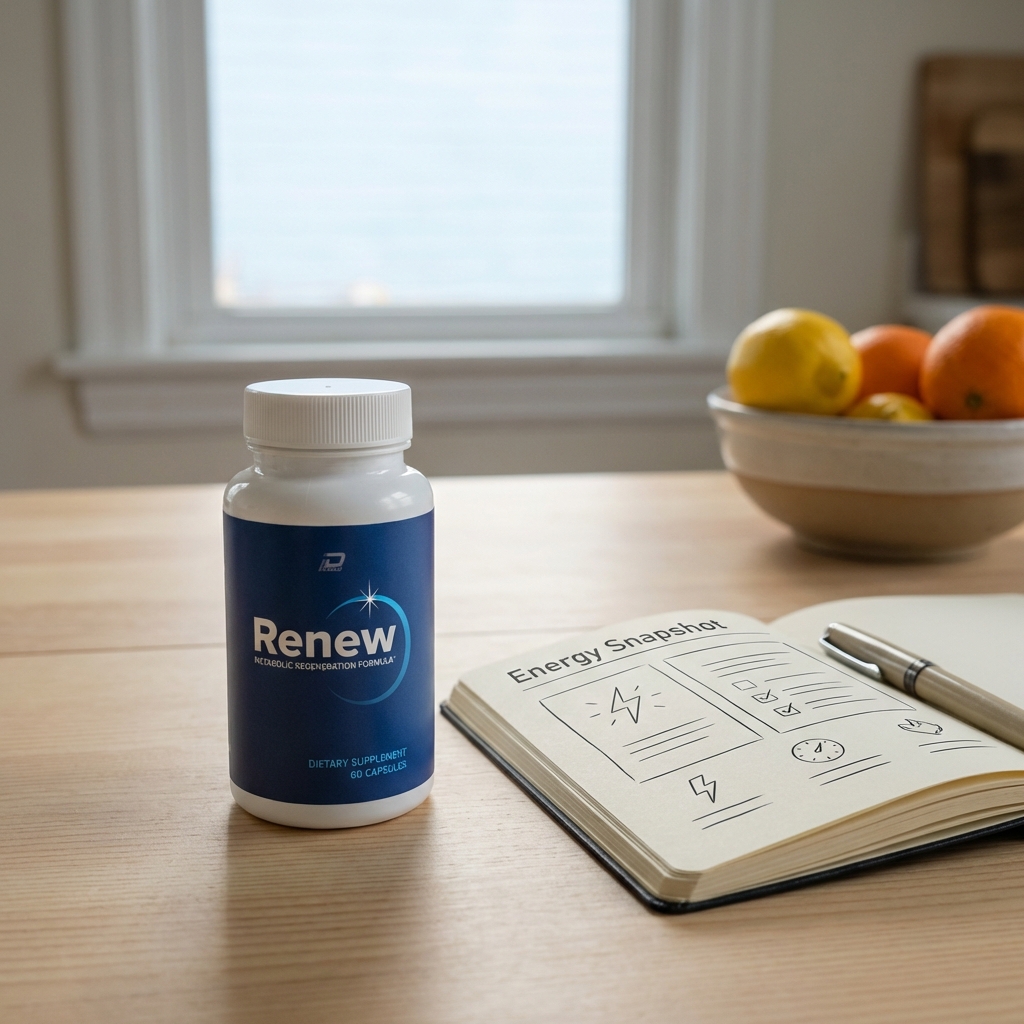
That’s when I started using Renew, a nighttime sleep-support formula.

Turn Down the Night Noise
If your body is tired but your mind won’t quit, this is for you
Renew is a bedtime supplement designed to help you fall asleep faster and settle into a calmer state—so your system can finally stand down. It combines 10mg melatonin, 200mg L-theanine, and 150mg ashwagandha—a simple, repeatable formula you take with water before bed.
-
Helps quiet the “wired-tired” loop
-
Supports a smoother wind-down routine
-
Makes bedtime feel more predictable
Not as a cure. Not as a shortcut.
As a reliable signal that helped my body access the deeper rest it kept circling but couldn’t land in.
The first shift I noticed wasn’t the morning. It was the quality of the night.
My mind stopped grabbing at thoughts. My body stopped buzzing with low-level tension. The exhausted-but-wired feeling softened. And when sleep became restorative instead of just time spent horizontal, everything downstream improved.
What recovery actually looks like
I didn’t become a different person. I became a more consistent version of myself.
The changes were quiet but cumulative:
- Normal days stopped requiring a recovery day afterward
- Brain fog cleared in increments I could feel
- My emotional regulation steadied—less reactivity, less brittleness
- I made plans without the fear of crashing halfway through
- Caffeine became a preference, not a personality
When inflammation cools, your body stops running background programs that drain your battery. When your immune system isn’t constantly scanning for danger, energy stops leaking out through invisible cracks.
Wake Up Less Drained
Deep sleep is where your body actually refuels
Renew is built to support deeper, more restorative sleep—the kind that helps you wake up feeling more steady. Its blend includes 100mg hydroxytryptophan (5-HTP) plus 50mg magnesium and 15mg zinc to support sleep quality and morning alertness. It also includes 1200mg arginine + 1200mg lysine, added for overnight support while you’re resting.
-
Supports deeper-feeling nights
-
Helps mornings feel less foggy
-
Fits a simple nightly routine
That’s the understated victory.
Not transformation. Not perfection.
Just your life feeling possible again.
Tracking the pattern without self-judgment

If you need evidence to trust what’s happening, tracking can help—as long as it stays compassionate.
I didn’t track to judge. I tracked to notice correlation.
A simple daily energy snapshot worked:
- Morning: How charged do I feel on a scale of 1–10?
- Midday: Do I crater or hold steady?
- Evening: Do I crash hard or wind down naturally?
- Sleep: Do I wake restored or still carrying yesterday?
Over weeks, patterns emerged. And once you see the pattern, you can stop blaming your willpower for what’s actually physiology.
The quiet truth I carry now
If you’re living with that bone-deep exhaustion—the kind that makes you feel like you’re dragging your entire life behind you—listen:
You’re not weak.
You’re not broken.
Your body might be trying to protect you the only way it knows how.
Inflammation, fatigue, and the immune system can interlock in ways that leave you feeling slow, foggy, and hollowed out. But when you begin turning down the volume—through deeper sleep, steadier nutrition, nervous system regulation, and real recovery—your energy can return in a way that feels earned, not forced.
For me, Renew became a tool that made rest feel accessible instead of elusive. Not the whole answer. Just reliable support that didn’t require me to overthink it.
And honestly?
That alone was worth everything.
Written by Elias Menden — for those who seek steady energy in a noisy world.