I was halfway up a ladder with a drill in my hand when I noticed it. Not pain, exactly. More like a warning. My right elbow—the one I’ve used to drive ten thousand screws, haul lumber, torque bolts in tight spaces—just felt wrong. Thick. Like someone had quietly filled the joint with sand overnight and didn’t leave a note.

I finished the job. You always finish the job.
But driving home that evening, gripping the wheel with hands that felt ten years older than the rest of me, I kept thinking about how easy it used to be. How movement used to just happen—without negotiation, without aftermath, without me doing a quiet inventory of what tomorrow might feel like.
That was the moment I started taking the question seriously: was there anything in the world of best anti-inflammatory supplements that could actually help a working person feel more like themselves again? Not a spa person. Not a biohacker. Just a guy who uses his hands all day and needs them to keep showing up.
⸻
The moment I realized I didn’t just want “less pain”—I wanted less friction
Joint discomfort is strange that way. It rarely announces itself with a dramatic event. It sneaks in through the side door.
- You hesitate before kneeling on concrete.
- You shift your grip more often than you used to.
- You wake up and spend the first few minutes of every morning waiting for your fingers to decide they’re participating.
- You start doing quiet mental math before physical tasks—if I push hard today, what does tomorrow cost?
That last one is the one that wore me down. Because I’m not built for caution. I’m built for doing. And somewhere between the job sites and the weekends and the years of honest physical work, my joints had started asking for terms I wasn’t sure I could meet.
I didn’t want to slow down. I wanted to find a way to stay in the game without the constant negotiation. So I stopped searching for miracles and started looking for support—something that could help my body feel less reactive from the inside—so I could stay focused on the work instead of the warning signals.
My real-world test for the best anti-inflammatory supplements

I used to choose supplements the way most people do: an eye-catching label, a few reviews, a hope. That got expensive fast. And I’m not a patient man when something isn’t working.
Eventually I stopped picking randomly and started filtering for three things. Nothing complicated—just a way to protect myself from hype and keep my head straight.
- I needed ingredients with a real reason to exist.
- I needed a felt difference—not a dramatic promise.
- I needed something I’d actually stick with.
I wasn’t looking for a miracle. I was looking for the quiet version of better: less stiffness in the morning, easier movement by mid-afternoon, fewer moments where my body second-guessed my intentions. Because here’s the thing nobody talks about: the best supplement on earth is useless if it doesn’t fit inside your real life.
Pill fatigue is real. Complicated routines get abandoned on busy weeks. Consistency isn’t a willpower problem—it’s a fit problem. That third one changed how I evaluated everything.
⸻
What I learned about inflammation (without turning it into a science lecture)
Your body’s inflammatory response isn’t the enemy. It’s a mechanism. A smoke alarm.
The problem is when the alarm never fully resets. When your body stays in a low, simmering state of readiness—like it’s always expecting a fight, even when you’re just sitting at a workbench eating lunch. That’s when joints start feeling cranky. Tight. Hot. Like they’re carrying a grudge.
And here’s what I wish someone had told me earlier: you don’t always feel inflamed as an obvious, identifiable thing. Sometimes you just feel slower. Stiffer. Like your range of motion got quietly trimmed overnight. Like your joints are operating at 85% and you’ve just… accepted it.
The supplements that actually helped me weren’t the ones promising to bulldoze symptoms. They were the ones aimed at building a calmer internal environment—so my body wasn’t constantly braced against itself.
The classic staples that earned their spot

Some ingredients keep showing up in conversations about inflammation and joint health because they’ve earned it. I was skeptical of that for a long time. Now I respect it.
Omega-3s: the quiet foundation
Omega-3s didn’t feel like a revelation. They felt like laying groundwork. When I stayed consistent, mornings felt less rusty. My joints weren’t as easily irritated by the kind of sustained physical work that’s just part of my day.
The issue for me was the form—some fish oils left a taste I couldn’t stand, and a few formulas didn’t agree with my stomach before an early shift. Details matter here. Smaller softgels, better quality oil, taking it with food. The version that fits your day is the one that will actually help you.
Turmeric (curcumin): the one I noticed when I stopped
Turmeric was subtle in a specific way—I didn’t feel much at first, but when I went off it for a couple of weeks, I noticed I missed it. That absence told me more than the presence did.
On days where my body felt tight and stubborn by noon, turmeric seemed to take the edge off. Not dramatically. More like adjusting a temperature dial by two degrees. You don’t notice it instantly; you notice it when the room feels right.
Bioavailability matters with curcumin. Without it absorbing properly, you’re mostly wasting your time and money. Consistency matters too. Turmeric isn’t a quick fix—it’s a steady nudge.
Boswellia: the sleeper hit
This one surprised me. Boswellia didn’t get the social media attention that turmeric did, but for the specific kind of ache that comes from sustained use—elbows after a long day carrying, knees after hours on a concrete floor—it felt like it quietly addressed what the others missed.
What I liked most was how clean it felt. No energy spike. No weird side effects. Just a softer quality to movement, especially toward the end of a hard day when my joints had been through it.
Collagen peptides: not inflammation exactly, but still a comfort tool
Collagen wasn’t targeting inflammation directly, but joint comfort is about more than inflammation alone. I started mixing it into a morning drink and after several weeks noticed movement felt less—not pain-free, just smoother. Like something was better lubricated.
There was also a psychological shift that surprised me: adding collagen made me feel like I was caring for my joints instead of just reacting to them. That mental reframe matters more than it sounds.
⸻
The problem I didn’t expect: too many bottles, too much noise
Here’s how my attempt at building a smart supplement routine actually went:
- I found a few things that helped.
- Then I kept adding.
- Then I had a stack—five products, different schedules, competing with each other for space in my morning.
And instead of feeling supported, I felt managed. Like my joint health had become its own part-time job. The routine was supposed to make things easier. Instead it was just a different kind of friction.
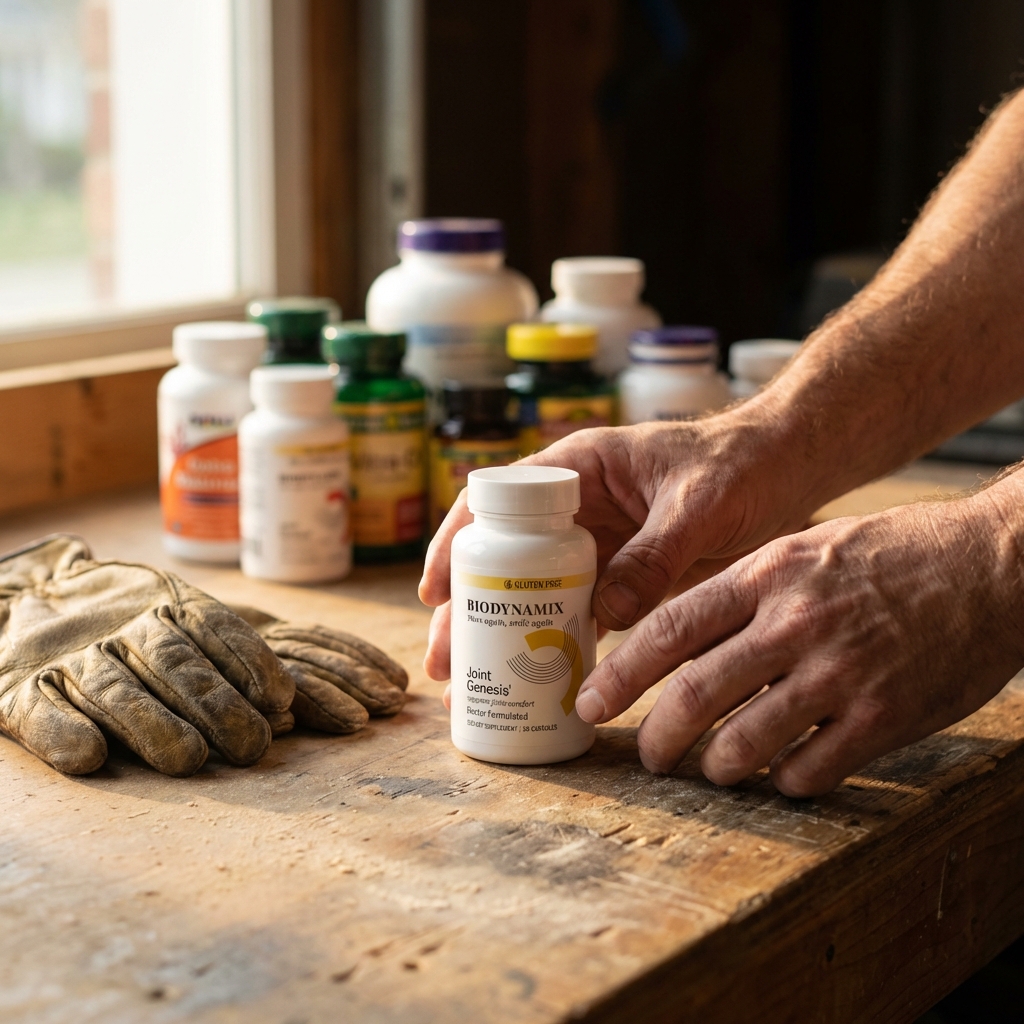
Make joints feel smoother
The goal isn’t “more pills.” It’s less grit in your movement
I kept chasing “anti-inflammatory” lists until I found the real problem: friction. Joint Genesis is built around Mobilee®—a joint-lubrication complex that includes hyaluronic acid, collagen, and polysaccharides. It’s made to support the “glide” your joints miss when mornings feel rusty.
-
Supports joint lubrication for easier-feeling movement
-
Helps mornings feel less “grindy” over time
-
One daily anchor you’ll actually keep
What I actually needed was one thing I could reach for without thinking—a daily anchor that handled the joint-specific work without demanding a degree in supplementation to use it properly.
That’s when I found Joint Genesis. Not because it promised to change my life. But because it matched where I was: a simple, joint-focused blend designed around comfort and mobility support, with no circus of pills to manage around it.
Best anti-inflammatory supplements: the questions that actually helped me choose
If you’re standing in front of an overwhelming shelf—physical or digital—trying to make sense of the options, here’s what I’d ask instead of reading another top-ten list:
- Do I want broad inflammation support, or targeted joint comfort?
- Am I okay managing several products, or do I need one daily anchor?
- Does the label tell the truth clearly?
- Can I commit to this long enough to know if it works?
Those aren’t always the same thing, and conflating them leads to buying products that aren’t quite aimed at what you need. Honest answer only. Your real life, not your ideal life.
If the ingredients are hidden behind a “proprietary blend” with no amounts listed, that’s a flag worth taking seriously. Because two weeks isn’t enough for most of these ingredients to show you what they’ve got.
When I finally answered those honestly, my supplement journey stopped feeling like a treasure hunt and started feeling like a decision I could live with.
Omega-3s helped, but required attention to form and timing. Turmeric helped, but only when I stayed consistent. Boswellia helped, but I was still managing the rest of the stack around it. Collagen helped, but wasn’t my main lever.
Joint Genesis became the option that simplified all of it—the one that reduced the mental overhead while still supporting the joint comfort I was actually after.
The shift I didn’t see coming

A few weeks into a simpler routine, something changed that I didn’t have language for at first. I stopped scanning. I stopped waking up and immediately flexing my hands to see what kind of morning it was going to be. I stopped pausing at the bottom of stairs. I stopped doing that mental calculation before committing to a full day of physical work.
My body hadn’t become invincible. But my baseline felt different. Less on edge. Less braced.
You move, and it just happens.
And that’s a hard thing to explain to someone who hasn’t felt it—because it’s not really about what you gain. It’s about what you stop losing. The energy you used to spend quietly negotiating with your own joints. The plans you used to make with asterisks attached.
That’s the goal. That’s what I was looking for the whole time.
What to look for when you’re shopping (so you don’t get played)

Supplement marketing is loud. Everyone is promising the same five adjectives with a different logo. So here’s the simple version of how I stayed sane:
- Pick one goal.
- Try one new thing at a time.
- Give it a real window.
- Track your average days, not your best ones.
Morning stiffness? End-of-day ache? Overall mobility? Name it. Then shop for that specifically. Otherwise you’ll never know what’s helping and what’s just expensive peace of mind. Not forever—but long enough to see a pattern. Four to six weeks minimum for most joint-focused supplements.
Real improvement shows up on ordinary Tuesdays, not on the days you happened to sleep perfectly and wake up feeling great. Two lines in your phone is enough: Morning stiffness—better, same, or worse. Movement later in the day—better, same, or worse. That’s your whole tracking system. Simple enough that you’ll actually use it.
⸻
The quiet permission moment
If you’re reading this because your joints have been talking to you—through a dull ache, a morning pause, a hesitation you’ve started accepting as normal—I understand it.
There’s a specific kind of fatigue that builds up when you’re limited by your own body. Not just the physical part. The thinking about it part. The constant background awareness that takes energy you’d rather spend elsewhere.
The biggest win for me wasn’t finding some exotic, rare ingredient nobody had heard of. It was finding a rhythm I could actually sustain.
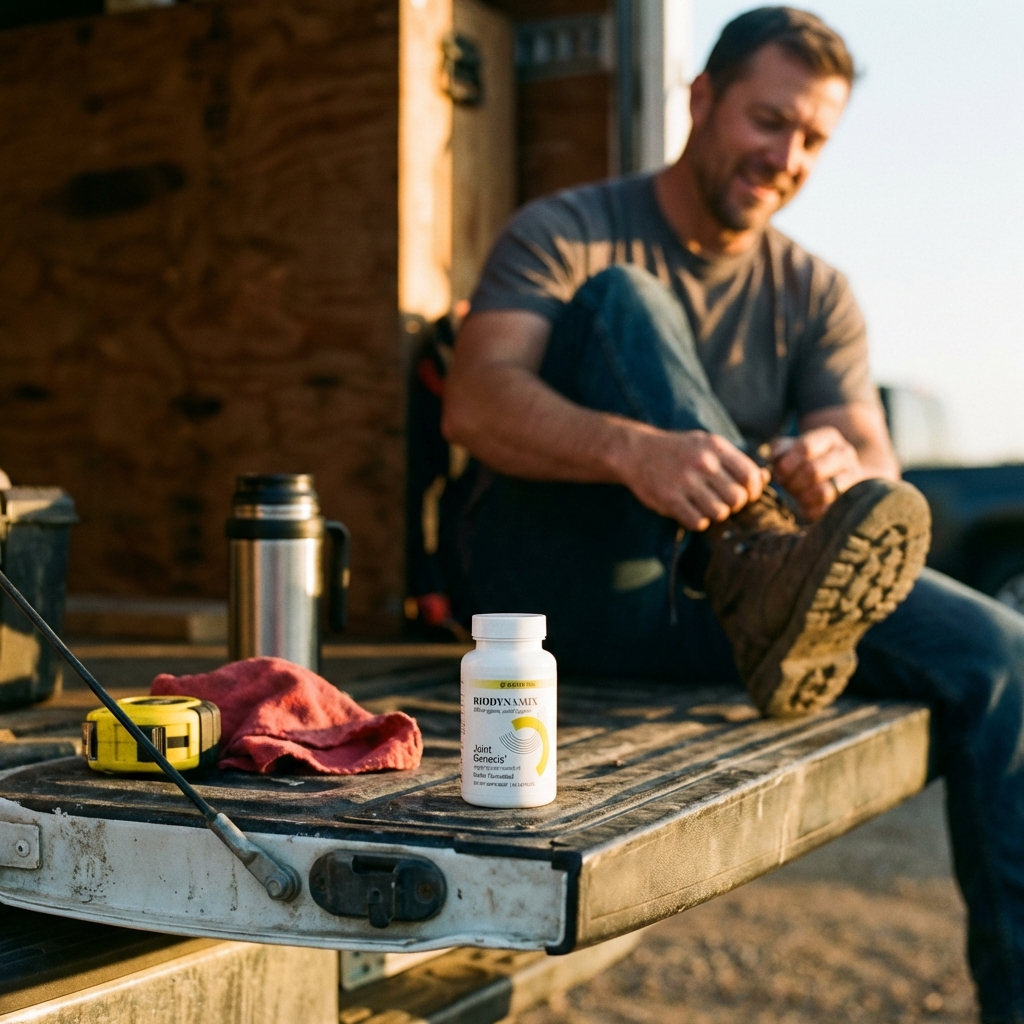
Calm the after-work edge
The “end-of-day cranky” feeling doesn’t get to run the show
Joint Genesis is the blend I stick with because it covers the “daily wear” side too. It contains French maritime pine bark extract, boswellia serrata, ginger root, and BioPerine® (black pepper extract for absorption). One capsule a day, built to support joint comfort, flexibility, and a calmer feel after heavy use.
-
Supports everyday joint comfort after hard work
-
Helps keep movement feeling more free
-
BioPerine® helps your body use it well
That’s why Joint Genesis stayed in my routine. Not because it fixed everything overnight, but because it felt like support that respected the way I actually live—with early mornings, long days, and no patience for complicated protocols.
That’s what I’d call the real definition of the best anti-inflammatory supplements: the ones you can stay with long enough to feel your body settle back into itself.
Closing thought: the goal isn’t perfection—it’s ease
I used to think joint health meant finding some big turning point. Some product that would draw a clean line between before and after. Now I think it’s quieter than that.
It’s opening a jar without noticing your hands. Standing up without that small pause you’d stopped counting as a pause. Walking to the truck at the end of a long day and realizing you’re not bracing for tomorrow.
If you’re searching for the best anti-inflammatory supplements, I hope what I’ve shared helps you choose with less noise and more clarity. Your body doesn’t need you to be extreme about it. It needs you to be consistent—with something that fits the life you’re actually living.
You deserve to feel dependable in your own skin again. That’s not a luxury. It’s just what it feels like to be whole.
Written by Elias Menden — for those who seek steadier strength.
Related reading
- Anti-Inflammatory Cooking for Joint Health: The Pantry Overhaul That Changed How I Move
- What I Eat for Joint Pain: My Anti-Inflammatory Diet for Joints Plan
- Anti-Inflammatory Diets for Cellular Health: What Works Best
- Best Anti-Inflammatory Supplements for Digestive Relief: The Gut Reset That Finally Made My Body Exhale