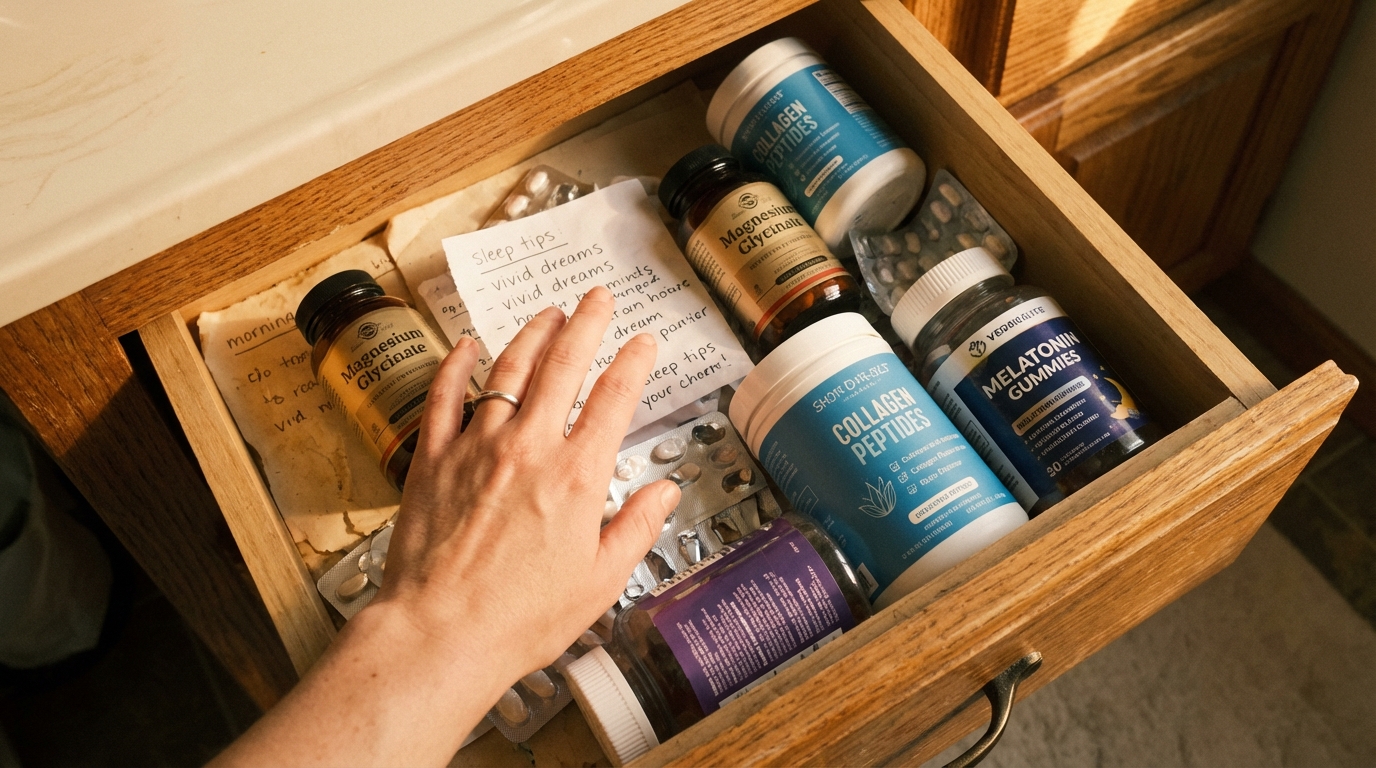
There’s a drawer in my bathroom that tells the story better than I can.
Three half-used bottles of magnesium. A melatonin gummy jar with the cap barely on. An adaptogen blend someone at work swore by. Two different collagen powders — one vanilla, one unflavored, both abandoned after week three. Every single one of them was supposed to help. Every single one came with a promise I wanted to believe.
And every morning, I’d wake up the same way: stiff, foggy, dragging myself toward the coffee maker like my body hadn’t slept at all. I wasn’t sick. I wasn’t skipping meals or staying up until 2 a.m. I was doing the things. And yet something inside me felt stuck — like my body was falling behind a clock I couldn’t see.
It took me longer than I’d like to admit to stop blaming my habits and start looking at what was actually happening under the surface. Not at the symptom level. Deeper. At the level of my cells.
When Doing Everything Right Still Isn’t Enough

There’s a version of tired that doesn’t make sense on paper. You track your sleep. You eat well. You move your body. And when someone asks how you’re doing, you say “fine” — because technically, you are. There’s just this gap between what your routine says about you and how your body actually feels.
That gap has a name. It’s called impaired cellular repair.
Every day, your cells take hits. Stress hormones, environmental toxins, inflammation, even the basic process of converting food into energy — all of it creates damage at the cellular level. And every night, your body is supposed to fix it. Old mitochondria get cleared. Damaged proteins get recycled. DNA gets patched and reassembled.
But here’s the part nobody talks about at the supplement counter: that repair process doesn’t happen evenly across the night. The deepest phase of sleep — what researchers call slow-wave sleep — is when most of your cellular regeneration actually takes place. Your growth hormone peaks. Autophagy kicks in. Your mitochondria rebuild.
And if that phase is compromised — shortened, interrupted, or too shallow — your cells don’t get the repair window they need. Not in a dramatic way. Just enough that your mornings feel heavier. Your recovery takes longer. Your skin looks duller than your hydration should allow. Your joints ache in places they didn’t last year.
You’re aging. Not because of bad choices. Because the repair process isn’t finishing the job.
The Science Most Supplements Ignore

Walk through any wellness aisle and you’ll see the same pattern: individual ingredients marketed toward individual symptoms. Collagen for skin. Ashwagandha for stress. CoQ10 for energy. Melatonin for sleep. And none of those are bad things. But they’re working on the edges of a problem that lives deeper.
The real bottleneck for most people over thirty-five isn’t a single nutrient deficiency. It’s that their body’s nightly repair cycle — the one that keeps cells young, mitochondria efficient, and energy production stable — has quietly slowed down. Blue light, chronic low-grade stress, disrupted circadian rhythms, overstimulation before bed — all of it chips away at the quality of deep sleep, and deep sleep is where cellular repair lives.
Supplements for cellular repair need to do more than deliver one molecule. They need to support the biological conditions that allow your body’s own restoration systems to function. That means supporting deep sleep architecture. Protecting mitochondria. Giving your cells the raw materials for the cleanup process that happens in those critical overnight hours.
This was the shift that changed everything for me — realizing that the answer wasn’t more ingredients. It was the right support at the right time, aimed at the right layer.
⸻
What I Stopped Doing (and What I Started Instead)
I stopped buying supplements based on ingredients lists and started paying attention to what they were actually designed to do.
NAD+ precursors made sense to me biologically. NAD+ is a coenzyme your cells need for energy metabolism and DNA repair. Levels decline steadily with age, and when they drop, your mitochondria lose their ability to function efficiently. Supporting NAD+ pathways is one of the most direct ways to give your cells what they need to rebuild overnight.
Antioxidant compounds that target mitochondrial stress — not just surface-level inflammation — also made sense. Your mitochondria generate energy, but in the process, they produce oxidative byproducts. Without protection, those byproducts damage the very structures doing the work. It’s like running an engine with no oil filter.
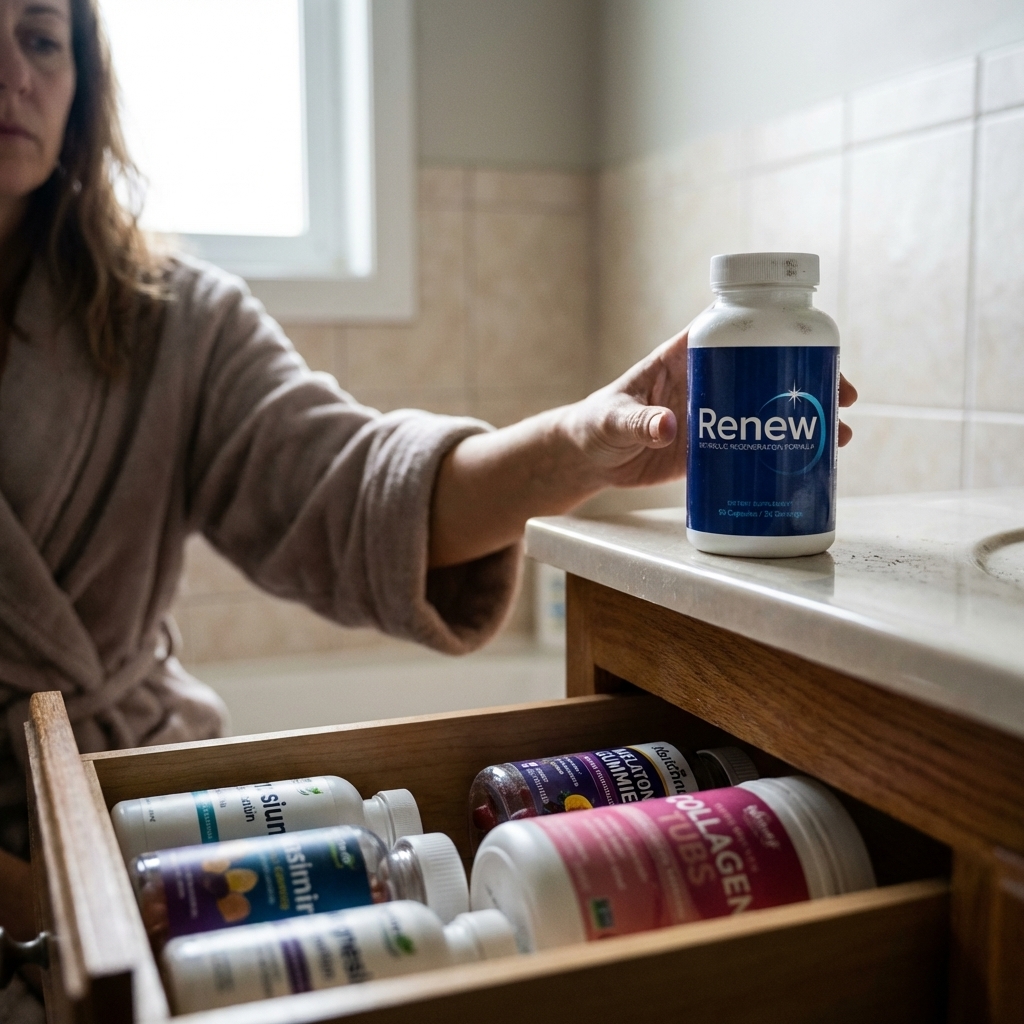
This Is the One I Kept
I was done buying single-ingredient promises that never changed my mornings
Renew made sense because it was built around the deeper issue. Based on the blog draft, it combines NAD+ precursors with mitochondrial antioxidant support in one nightly formula. That means it is positioned to support the energy systems your cells rely on and help protect them during overnight repair.
-
Includes NAD+ precursors for nightly cellular energy support
-
Includes mitochondrial antioxidant support for oxidative stress defense
-
And deep sleep support — not sedation, not drowsiness, but actual support for the slow-wave phase where regeneration happens — turned out to be the missing piece I’d been ignoring while chasing individual symptoms.
When I found something that addressed all three of those layers in one formula, I stopped shopping. That’s when I found Renew.
⸻
What Changed When the Repair Window Opened
Renew wasn’t like anything else in that bathroom drawer. It wasn’t targeting one symptom or loading up on a trendy ingredient. It was designed around the biology of deep sleep — the idea that if you restore the quality of your body’s most critical repair phase, the downstream effects touch everything.
I didn’t notice a dramatic shift the first few nights. What I noticed was the absence of something. That gritty, unrested feeling I’d been waking up with for months — the one where your eyes are open but your body hasn’t caught up — started to fade. Not because I slept longer. Because something about the sleep itself felt different. Denser. More complete.
By the second week, my mornings had a quality to them I hadn’t felt in a long time. Not buzzing energy. Just… readiness. My mind was clearer before coffee. My body felt like it had actually used the night to do something useful — like the maintenance crew had finally shown up after months of skipping the shift.
The stiffness in my hands — the kind I’d been chalking up to “just getting older” — started loosening. My skin looked less tired. Not younger, exactly. Just less worn. Like it was holding moisture again.
I don’t want to oversell this. Nothing about it felt like a miracle.
It felt like a return.
Like my body remembered how to do something it had been struggling to finish.
Why Deep Sleep Is the Missing Variable

Most anti-aging conversations focus on what you put in during the day. The right protein. The right antioxidant. The right mineral at the right dose. And all of that matters. But if your body doesn’t have the overnight repair window to actually use those materials, they’re just passing through.
Deep sleep isn’t just rest. It’s a metabolic event. Growth hormone surges. Autophagy — your body’s built-in cellular cleanup system — accelerates. Brain waste gets flushed. Muscle tissue gets repaired at the fiber level. Mitochondria that have been damaged during the day get tagged, dismantled, and rebuilt.
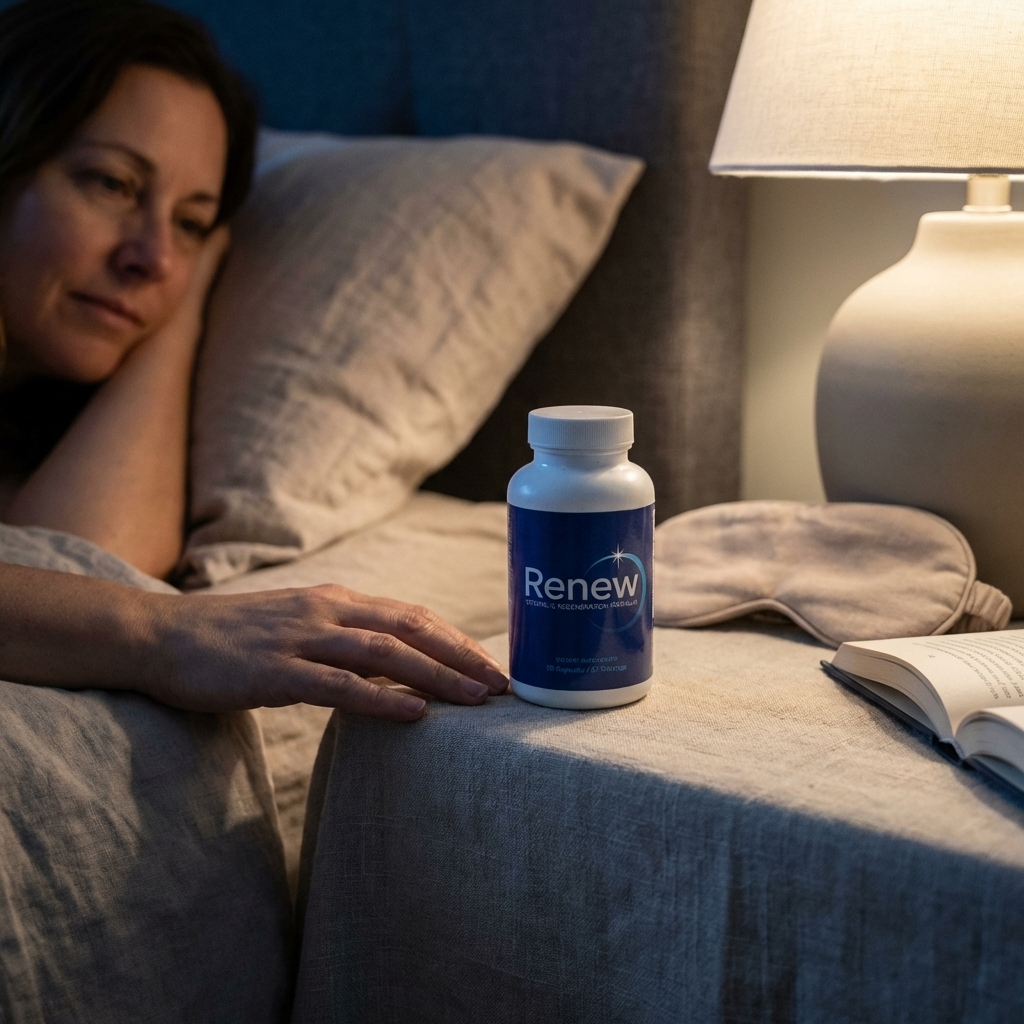
Don’t Just Sleep Support Deep Sleep
What changed for me was not more sleep hacks. It was backing the right phase of sleep
The blog positions Renew as a nightly formula with deep sleep support aimed at the slow-wave phase, the stretch of the night linked to cellular cleanup and restoration. That is why it fits this story so well: it is not sold as random bedtime drowsiness, but as support for the overnight repair window itself.
-
Built around deep sleep support, not just bedtime ritual
-
Matches the blog’s focus on the slow-wave repair window
-
Made for people who want to wake up feeling more restored, not just knocked out
When that phase shrinks — even by twenty or thirty minutes — the effects ripple through everything. Slower recovery. Lower energy. More inflammation. Faster visible aging. Not because of something you did wrong during the day, but because your body didn’t get to finish what it started at night.
This is why supplements for cellular repair that ignore sleep quality are only solving half the equation. And it’s why Renew made more sense to me than anything I’d tried before — because it wasn’t asking me to add another pill to my morning stack. It was helping my body do what it already knows how to do, in the hours when it matters most.
⸻
The Feeling You Forgot You Were Missing

There’s a morning I keep coming back to. A Thursday. Nothing special about it. I woke up five minutes before my alarm, and instead of lying there dreading the effort of standing up, I just… got up. My feet hit the floor and my body felt like it belonged to someone who’d actually rested.
I made coffee because I wanted the taste. Not because I needed it to function.
That’s what cellular repair feels like when it’s actually happening. It doesn’t announce itself. There’s no single moment where everything changes. There’s just a slow lifting of weight you didn’t realize you were carrying. A quiet recalibration. Your body starts keeping pace with your effort again.
If you’ve been doing all the right things and still feeling like something’s off — if you’ve got your own drawer full of half-used bottles and good intentions — the answer might not be another ingredient. It might be giving your cells the repair window they’ve been missing.
That’s all it was for me. And honestly, I wish I’d found it sooner.
Written by Elias Menden — for those who seek steady energy and quiet strength.