There is a particular kind of ache that greets you when you open a car door after a long drive. Not a dramatic pain. More like a quiet protest — your knees reminding you, firmly and without apology, that they have been folded in the same position for three hours and they are not pleased about it. If you know that feeling, if you have done the careful sidewalk shuffle while your joints wake back up, then this is written for you.
I started paying attention to my knees last year, not because something dramatic happened, but because that shuffle was getting slower. And I was tired of it. This is my honest account of what I tried, what I learned about why long car rides feel so punishing on joints, and how Joint Genesis quietly changed the picture for me.
I want to be straight with you from the start: I am not a doctor, and I am not here to promise miracles. What I am is someone who spent months ignoring a slow, creeping stiffness — and then spent a few more months actually doing something about it. The biology behind what happens to your joints during long periods of sitting is more interesting than most people realize. And once you understand it, the right kind of support starts to make a lot more sense.
The Quiet Damage That Happens When You Stop Moving

Your joints are not designed for stillness. They are built for movement — specifically because movement is what keeps them nourished. Inside every major joint, including your knees and hips, there is a lining called the synovial membrane. It produces a thick, gel-like fluid that cushions the cartilage, reduces friction, and delivers nutrients directly to joint tissue. Cartilage itself has no blood supply. It depends entirely on this fluid — and on the compression and release of movement — to stay hydrated and healthy.
When you sit in a car for hours, two things happen simultaneously. First, the synovial fluid in your knee joint stops circulating the way it should — it becomes less effective at lubricating the joint surface. Second, the sustained compression on the cartilage — combined with the fixed angle of a bent knee — begins to stress the tissue in a way that normal movement never would. The joint is loaded, but without the rhythmic relief that walking provides. By the time you step out of the car, that tissue is stiff, slightly swollen in some people, and genuinely unhappy.
This is not weakness. This is physiology doing exactly what it does. The question is what you do with that information.
Curious what’s actually happening inside a stiff joint?
Why Some Knees Recover Fast and Others Don’t

You have probably noticed that not everyone shuffles out of a long car ride. Some people step out and walk immediately, no ceremony required. Others — and maybe you recognize yourself here — need a few cautious steps, a hand on the door frame, a moment to let things settle before trusting the joints to behave. Age is a factor, certainly. But age alone does not tell the whole story.
The deeper variable is the health of the synovial environment inside the joint. As we get older, synovial fluid production naturally slows down. The fluid becomes thinner, less viscous, less able to protect cartilage during stress. In younger joints — or in joints that are well-supported — recovery from a long period of stillness is fast because the lubricating system bounces back quickly. In a joint where that fluid is already running lean, recovery takes longer, and discomfort tends to linger past the point where it feels reasonable.
There is also the matter of inflammation. Cartilage breakdown — even minor, gradual breakdown — triggers an inflammatory response. In a resilient joint, that response is short and contained. In a joint under chronic low-level stress, the inflammatory signal stays elevated — and that is what makes the stiffness feel like more than just “sitting too long.”
Ready to stop reaching for the door frame?
What Most People Try First — And Why It Helps Only So Much

Stretching. Walking breaks. Adjusting the seat position. These are sensible responses, and they help. I tried all of them. The stretching loosened things temporarily. The walking breaks made long drives more manageable. But none of it addressed the underlying issue — the joint environment itself. You can stretch a tight muscle and feel immediate relief. You cannot stretch synovial fluid back into abundance. You cannot walk your way to thicker cartilage cushioning in an afternoon rest stop.
I also tried a standard glucosamine supplement for about six weeks. It did something — hard to say exactly what — but the results were modest and slow to appear. I did not feel confident it was actually changing the internal environment of the joint, or if it was just enough placebo effect to keep me patient. I wanted to understand the mechanism better. That curiosity is what eventually led me to Joint Genesis and, more importantly, to understanding what makes it different from the typical joint supplement on the shelf.
Your joints have been saying something for a while now.
What Joint Genesis Is Actually Targeting

Joint Genesis is built around a specific focus: synovial fluid quality and cartilage resilience. That distinction matters. Most joint supplements are formulated around pain relief — they approach the symptom. Joint Genesis approaches the system. The formulation supports the body’s ability to produce and maintain healthy synovial fluid, which means it is working on the lubricating environment inside the joint, not just numbing the signal that something is off.
The key compounds in the formula work together to support hyaluronan — a molecule that is central to synovial fluid viscosity. When hyaluronan levels are healthy, synovial fluid maintains its gel-like consistency and continues protecting cartilage surfaces effectively. When those levels drop, the fluid thins, friction increases, and the joint becomes more vulnerable to the kind of stress that long car rides deliver. By supporting the production and maintenance of this molecule, Joint Genesis is addressing the mechanics of the joint, not just masking discomfort.
There is also a meaningful anti-inflammatory component to the formula — not through suppression, but through cellular support that helps the joint tissue respond to stress more proportionately. Less inflammatory overshoot means faster recovery after the kind of sustained stillness that used to leave me walking carefully across a parking lot.
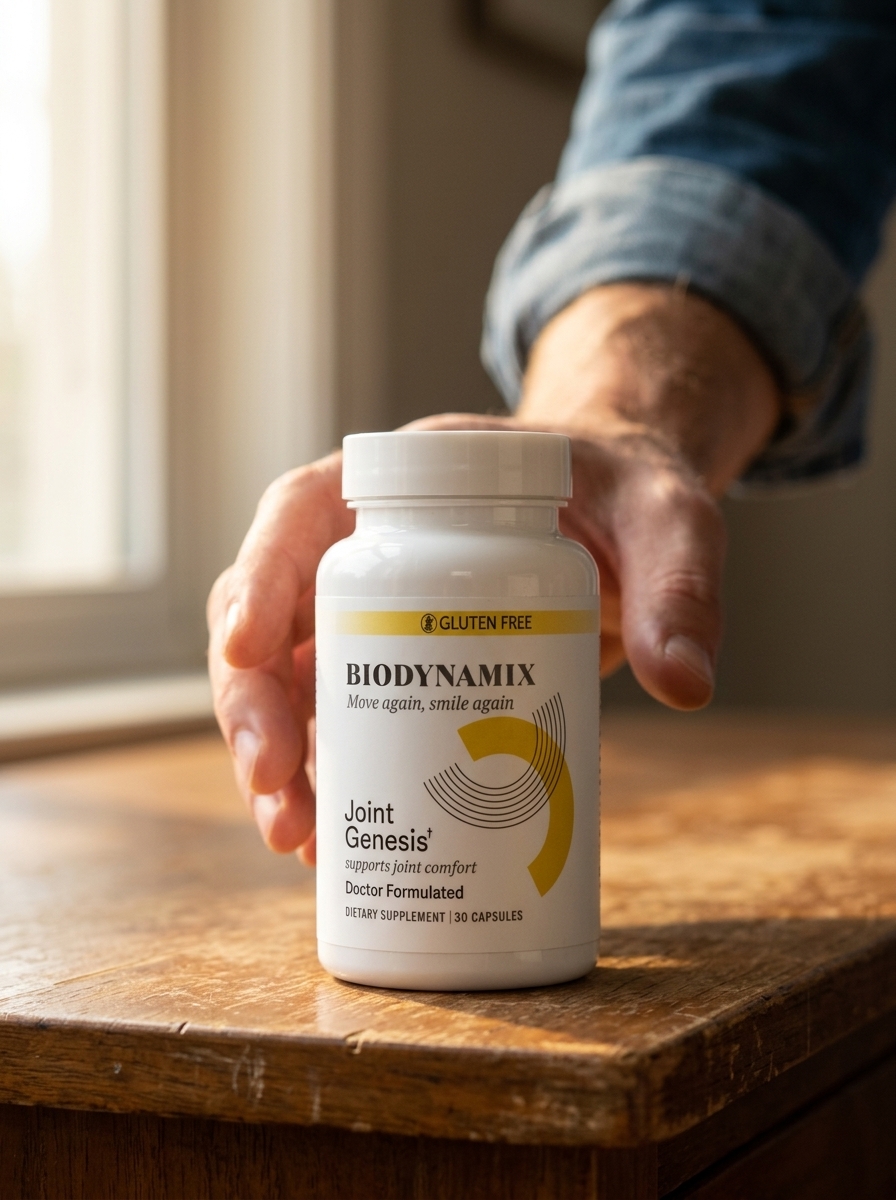
Built for the Long Drive
Stiffness after sitting is not aging — it’s your joint environment asking for support.
Joint Genesis targets synovial fluid quality and cartilage resilience — the internal mechanics that most supplements never touch. Formulated to support the lubricating system inside your joints, not just quiet the signal that something is off. Consistent daily use. Real, gradual change you can measure by how you move.
- ✓ Step out of the car without reaching for the door frame
- ✓ Mornings that don’t require a five-minute negotiation
- ✓ Movement that feels automatic again — stairs, walks, the day
What the First Few Weeks Actually Looked Like

I want to be honest about the timeline because I think a lot of supplement reviews skip this part. The first two weeks, I noticed almost nothing. I kept taking Joint Genesis consistently — one capsule in the morning with breakfast — and I kept doing the same drives, the same stretches, the same habits. I was watching for changes, but trying not to manufacture them.
By the end of week three, I noticed that I was not reaching for the door frame when I got out of the car after a two-hour drive. I did not make that connection immediately. It was only when I made a similar drive a few days later and stepped out cleanly — no pause, no cautious shuffle — that I realized something had shifted. The stiffness was not gone, exactly, but it was quieter. Less emphatic. More manageable.
By week six, the change was consistent enough that I stopped doubting it. Morning stiffness — which I had accepted as just part of my mornings — was noticeably shorter. The first five minutes after getting up from a desk no longer felt like my knees were renegotiating their contract with the rest of my body. That small, daily relief has a way of adding up to something that genuinely changes how you move through the day.
Most supplements address the symptom — this one addresses the system.
The Bigger Picture — Joints, Age, and What You Actually Control

There is a version of this conversation where we talk about joints as something that just wear out — like brake pads or shock absorbers. I understand why people think that way. The language around joint health is often framed in terms of degeneration, loss, and limitation. But that framing misses something important: the joint is a living system, and living systems respond to the conditions you create for them.
You cannot reverse decades of wear overnight. You cannot reclaim cartilage that has genuinely been lost. But you can change the internal environment of the joint — you can support the fluids, reduce the inflammatory pressure, and give the tissue the conditions it needs to stay resilient longer. That is not a small thing. That is the difference between a joint that gets more difficult every year and one that holds steady, that remains a reliable part of how you move and live.
Consistency matters here more than intensity. One good month followed by neglect will not carry you far. But a daily practice — a supplement that supports the system, a habit of movement, a respect for what your body tells you — that compounds over time in the same way stiffness compounds when you ignore it.
The shuffle does not have to be your default anymore.
What I Would Tell Someone Standing Where I Was

If you are still doing the parking lot shuffle — if your knees have been quietly telling you something for months and you have been answering with ibuprofen and patience — I am not going to tell you that one product will fix everything. Life is not built that way, and neither is joint health. What I will tell you is that understanding the mechanism changed everything for me. Once I understood that the problem was not just “tight muscles” or “getting older” but a change in the joint’s internal environment, the solution became clearer.
Joint Genesis gave me something I was not fully expecting: a sense of momentum. The stiffness did not disappear overnight, but it began to move in a direction I could trust. Long drives became less of an event I had to recover from. Mornings stopped being a negotiation. I started taking stairs without thinking about it — and that automatic quality, that return to movement without hesitation, is probably the most honest measure of what changed.
If any part of this resonates with you, I think it is worth taking seriously. Not because I say so, but because your joints have been saying so for a while now. Listening is the first step. Acting on what you hear is what actually moves things forward.
Written by Elias Menden — for those who seek strength that lasts longer than the drive home
Small daily support. Consistent results. Real change over time.