If you’re waking up drenched at 2 a.m.—if you’re forgetting words you’ve used a thousand times—if your mood feels like it belongs to someone else—you’re not imagining it. I know because I lived in that fog for months.
The night sweats came first. Not the gentle “I’m a little warm” kind. The kind where you wake up gasping, shirt plastered to your ribs, hairline soaked, and for three confused seconds you wonder if something’s actually wrong with you. Then the cold hits—that bone-deep shiver that makes you hunt for a blanket you just kicked to the floor.
That was January. Middle of winter. My bedroom window so cold it left condensation trails when I touched it.
My body? Running its own climate system with no regard for the thermostat.
But the nights were only half of it.
During the day, I’d open my laptop and stare. Not thinking. Just… gone. I’d lose the thread of conversations mid-sentence, grasping for words that used to come easy, then covering with a laugh while shame crept up my neck. And my temper—God, my temper—got a hair trigger I didn’t recognize.
I kept thinking: I just need more sleep. I just need to try harder.
Turns out you can’t willpower your way through perimenopause night sweats and brain fog. Not when your nervous system hasn’t rested in weeks.
⸻
The invisible weight nobody talks about

There’s a specific exhaustion that lives in the gap between “I look fine” and “I feel like I’m barely holding it together.” You still show up. You still perform. You still answer emails and make dinner and keep your face pleasant in meetings.
But underneath, you’re running on fumes and second-guessing everything.
For me, the cluster looked like this:
- Hot flashes at night that slammed me awake like an alarm I couldn’t turn off
- A restless, wired alertness at 2 a.m.—my body on guard duty while my mind spun
- Brain fog in perimenopause so thick I’d reread the same sentence four times and still lose it
- Mood swings that felt outsized, sudden, like stepping on a bruise I didn’t know was there
- A creeping whisper of What’s wrong with me? that I couldn’t shake
The sweat I could handle.
The self-doubt was harder.
Because when your symptoms are invisible—when there’s no blood test result you can point to and say, “See? This is real”—it’s easy to start bargaining with yourself.
Maybe I’m just not handling stress well. Maybe I’m just getting older and this is what it feels like. Maybe everyone else manages better and I’m just… failing.
That’s a lonely spiral.
The moment I stopped pretending I was fine
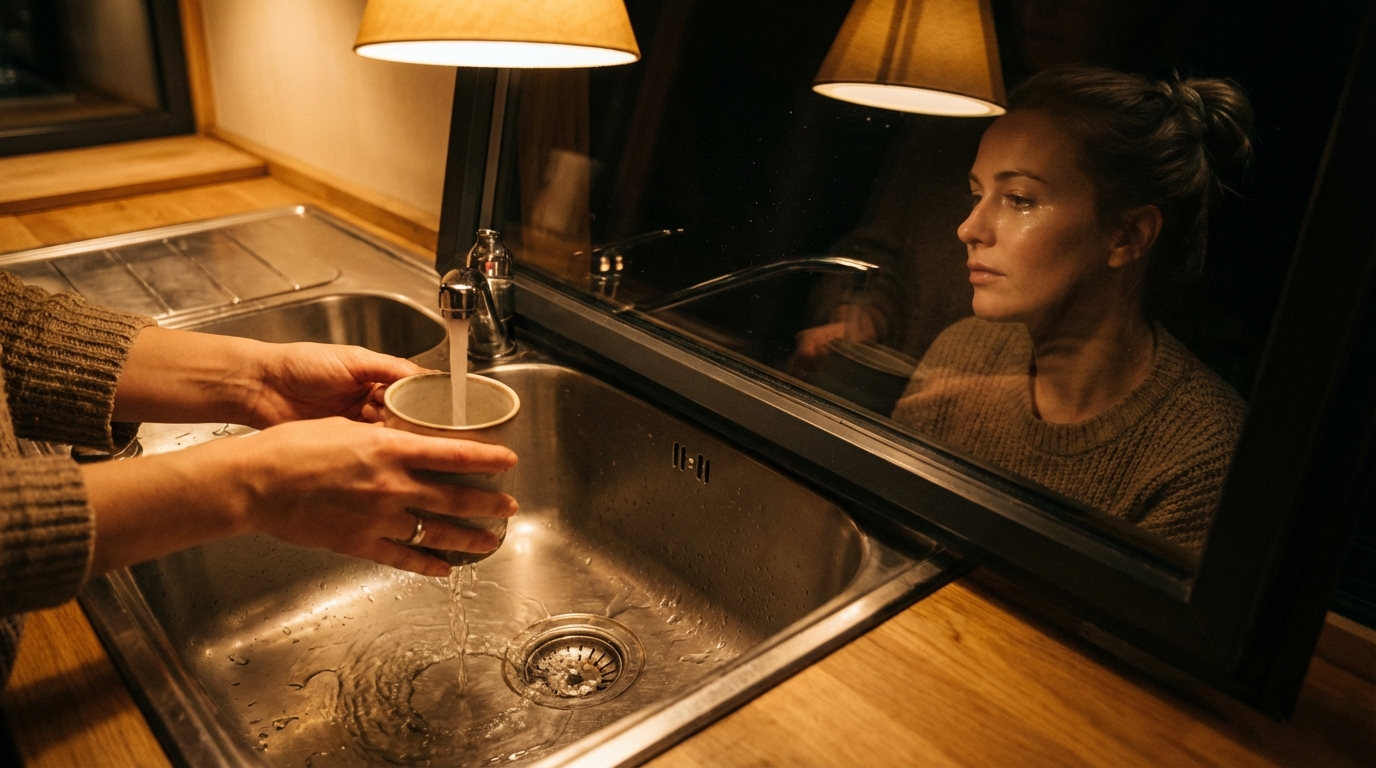
My turning point wasn’t dramatic. It was small and specific and didn’t fit the version of myself I thought I knew. A friend misunderstood something I’d said—a minor thing, the kind you normally clear up with a sentence. But instead of clarifying, I snapped. Hard. Fast. Way too sharp for the moment.
The second the words left my mouth, I felt it—that sickening wave of regret. Not just “Oops, my bad.” More like: That wasn’t me. Who said that?
Later that night I stood at the kitchen sink rinsing a coffee mug, watching water spiral down the drain, and felt tears push at the back of my throat for no reason I could name.
That’s when it landed:
I wasn’t failing.
My body was asking for help, and I hadn’t learned the language yet.
So I stopped being critical and started getting curious.
I ran hormone labs—not to label myself, but to see the map. And when the results came back showing the exact kind of fluctuation that explained the chaos, something unexpected happened:
I felt sane again.
Not fixed. Not instantly better. But believed. Like I wasn’t making it up or being dramatic or just “bad at life.”
That mattered more than I knew it would.
⸻
Why your body feels like it’s running a fever at midnight
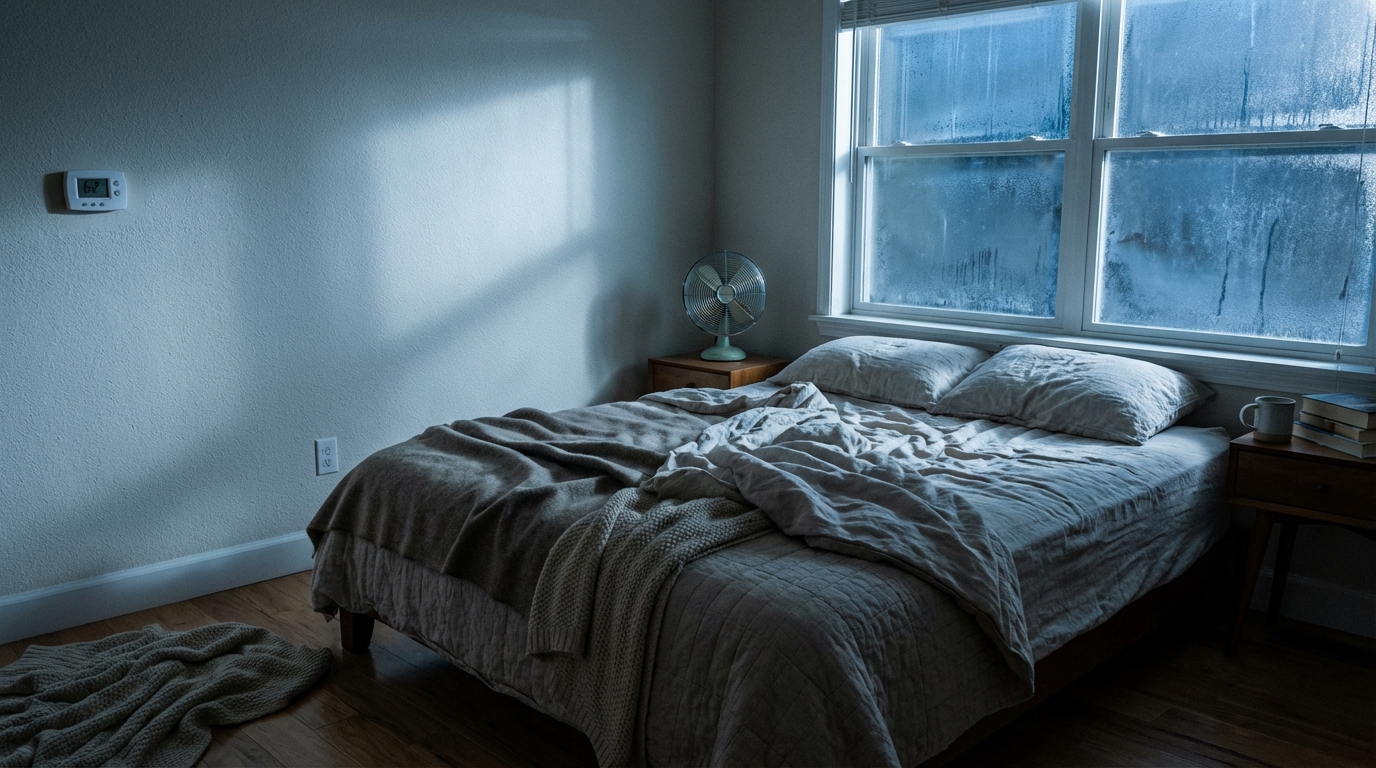
Here’s what finally made sense to me:
Perimenopause isn’t a steady decline. It’s a roller coaster.
Your hormones don’t just drop—they swing. Up one week, down the next, sometimes both in the same day. And when they swing, they take your body’s internal thermostat with them. That’s why you can go from sweating through your sheets to shivering under three blankets in the span of ten minutes.
When those heat waves interrupt your sleep—especially the deep, restorative kind—your brain never fully rests. The next day, everything feels louder. Your patience runs thinner. Your thoughts slip through your fingers.
It’s not a character defect.
It’s your nervous system trying to find balance on shifting ground.
Understanding that—really getting it—softened something in me. I stopped treating myself like a problem that needed fixing and started treating myself like a person moving through a hard transition.
What actually steadied my nights (the unglamorous truth)
I didn’t overhaul my life overnight. Every time I tried, I just added “failing at my new routine” to the list of things making me feel bad.
Instead, I focused on steadiness—small, repeatable choices I could manage even on the messy weeks.
Not perfection. Just rhythm.
Water (the thing I kept ignoring)
I used to drink water “when I thought about it,” which meant: almost never enough.
When I made it consistent—morning, midday, afternoon, then tapering off before bed—the night sweats didn’t disappear, but they lost some of their violence. Fewer wake-ups that felt like my body was in full panic mode.
My rule became stupidly simple: water all day, ease up at night.
Magnesium before bed
This one surprised me.
I didn’t expect much. But within a week, I noticed my body could actually downshift at night. My legs stopped that restless twitching. My mind stopped racing in circles.
Sleep wasn’t perfect, but it became something I could reach for instead of chase.
Movement that felt like care, not punishment
Hard workouts made everything worse. My body would hit back with worse sleep and sharper moods.
But gentle movement—long walks, slow yoga, bodyweight strength work that didn’t leave me wrecked—helped my nervous system settle. It gave the day somewhere to go instead of storing it all in my chest.
An evening that didn’t feel like a sprint to the finish line
I stopped treating bedtime like a deadline and started treating it like a landing strip.
Small shifts that added up:
- Lights dimmed after dinner
- A warm shower, then a cooler bedroom
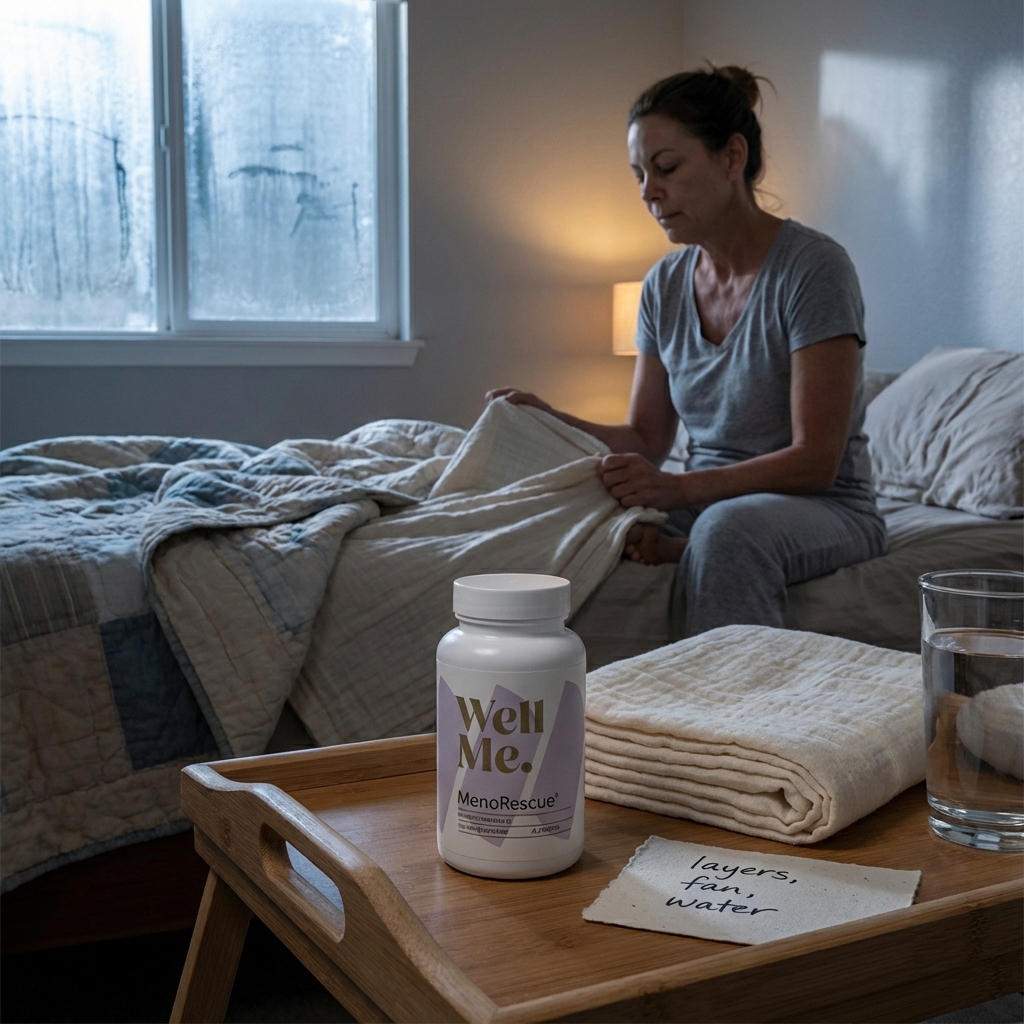
- A fan running for airflow, even in winter
- A lighter blanket I could layer instead of trapping heat
- Caffeine before noon (this one hurt, but it mattered)
The supplement I stopped debating: MenoRescue
I’m not someone who keeps things around just because.
Most supplements become half-empty bottles I eventually toss—another thing I started and quit and felt vaguely guilty about.
MenoRescue stuck because it was quiet. Not flashy. Not overnight magic. Just steady.
The first thing I noticed wasn’t even the sweating. It was the feeling that my body stopped running so hot at night—like I could lie down and my system would actually agree to rest instead of revving.
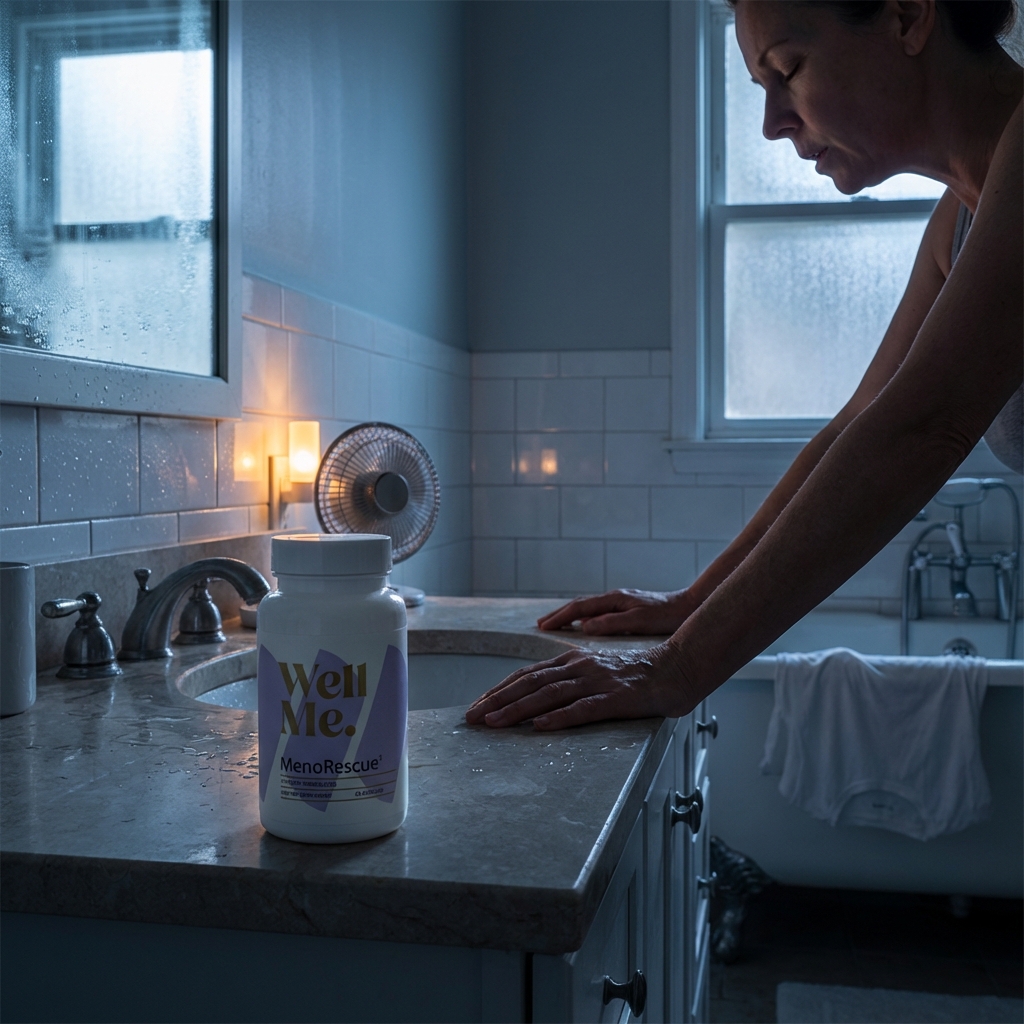
Turn Off the Revving
If your body snaps awake, you need support—not another pep talk
I use MenoRescue because it’s built to support healthy cortisol levels—so nights feel less “wired,” and days feel clearer. It contains Sensoril® ashwagandha (125 mg) plus Greenselect Phytosome® (caffeine-free green tea extract), Rhodiola rosea, and Schisandra berry.
-
Helps your system feel less on-guard
-
Supports a steadier, calmer wind-down
-
Makes focus feel more reachable
Over time, it became part of my “I don’t want to overthink this anymore” baseline. And that relief—not having to decide every day whether to take it or skip it or try something new—was its own kind of calm.
⸻
What I started tracking (because guessing made me crazy)

I’m not naturally a “track everything” person.
But perimenopause changed that.
Not because I wanted control—because I needed to stop blaming myself.
When I had a rough night, I’d jot down a few quick notes the next morning:
- Coffee after 2 p.m.?
- Did I actually drink water or just carry a bottle around?
- Heavy dinner? Spicy food?
- Stressed but pretending I wasn’t?
- Skipped magnesium?
- Scrolled too late and kept my brain lit up?
The patterns weren’t complicated. They were obvious once I looked.
Sometimes the reason was right there. Sometimes it wasn’t. But tracking turned “What’s wrong with me?” into “Oh—here’s the clue.”
And when I had a good stretch—three solid nights in a row—I wrote that down too. Because when you’re tired, it’s easy to forget you’re making progress.
When you feel like you’re losing the person you used to be
This is the part nobody warns you about.
The identity shake.
You know who you are. You know how you think, how you handle things, how you show up.
And then suddenly:
- Your focus fractures
- Your patience snaps at odd moments
- You lose words mid-thought—simple, everyday words
- You feel fragile in places that used to feel solid
If that’s where you are, let me say this as clearly as I can:
You’re not disappearing. You’re meeting yourself in a new season, and it takes time to learn the terrain.
That shift—from fighting to accepting—saved me more energy than any supplement ever could.
For me, the turning point wasn’t symptom-free living.
It was the morning I woke up and realized I didn’t feel afraid of my own mood anymore. I felt more like me—clear enough to think, steady enough to choose my response, kind enough to forgive the rough days.
That didn’t come from one perfect solution.
It came from stacking small acts of steadiness until they added up to something I could count on.
And yes—MenoRescue stayed in that stack, not because it was magic, but because it was reliable. A baseline I didn’t have to keep rebuilding.
The questions I hear most often
“Do perimenopause night sweats and brain fog eventually stop?”
For most people, they shift as your body settles into a new rhythm. What helped me wasn’t waiting for them to vanish—it was reducing the flare-ups with things I could actually control: hydration, steady evenings, fewer sleep disruptors.
“How long before you noticed a difference?”
Some changes showed up in weeks—especially around sleep quality. Others took longer. Your body responds to consistency, not intensity.
“What helped the mood swings most?”
Sleep. Always sleep first. When my nights improved, my days followed. And on the tender days, I treated my mood like data—more water, more movement, gentler evening, less caffeine, fewer demands.
Make Nights Less Wild
Hot-then-cold nights steal sleep—and sleep is everything
Here’s why I keep MenoRescue in my routine: it’s made to support healthy body temperature and steady hormone support during the transition. It contains Sage leaf (300 mg), Red Clover (80 mg), plus Black Cohosh, Chasteberry (Vitex), and BioPerine® (black pepper extract) to support absorption.
-
Helps nights feel less like a fight
-
Supports a smoother “cool down” routine
-
Keeps your next day from unraveling
If you’re awake at 3 a.m. reading this
If you’re here with tired eyes—if you’ve spent too many nights bargaining with the ceiling fan, wondering when you’ll feel normal again—please hear this:
This phase is hard. But it doesn’t have to be lonely.
You don’t need to fix everything at once.
Start with one steady thing. One repeatable act that tells your body: I’m listening now.
For me, that meant water I could count on, magnesium at night, evenings that felt like rest instead of rush, and one supplement I stopped second-guessing—MenoRescue—because it helped my nights feel less like warfare and more like a place I could actually land.
And if nothing else lands, let this:
Perimenopause night sweats and brain fog are real, and you deserve support—not shame.
⸻
Written by Liora Menden — for those who seek calm that lasts.