I used to wake before the house—dim light at the window, heater sighing on—and lie very still, waiting for the band to tighten across my chest. Not sharp. Just…pressure. People called it stress. I tried breathing apps, calming teas, the “you’re fine” pep talks. But the sensation felt physical, like my heart and lungs were pushing through a narrow doorway.
One morning I pressed two fingers against my sternum and listened past the noise. What if this isn’t just nerves? What if something under the surface is inflamed and my blood flow is working harder than it should?
That’s where the turning started.
When “anxiety” isn’t the whole story

Anxiety runs fast—racing thoughts, breath up in your throat. My tightness arrived even on quiet mornings. No mind tornado. Just a steady clamp.
As I learned more, the picture got clearer: low-grade inflammation can make tissues touchy, including the chest wall and the lining of our blood vessels. When vessels can’t relax, blood behaves like traffic at a narrowed lane. The heart still keeps the rhythm, but each beat has to push a little harder. That effort can feel like pressure.
I stopped arguing with the signal and started building a routine that lowered friction—less inner “static,” more room for flow.
The simple science I work with now

Plain English version:
- Your body uses a tiny messenger (nitric oxide) to tell blood vessels to relax and widen.
- Wider vessels = easier flow. Easier flow = less strain.
- Less strain, plus calmer inflammation, felt like someone loosened a notch on that invisible band.
I didn’t hunt for a perfect label. I built a life that helped the system breathe.
Practice over perfection: what changed the feeling

I began small, and kept what I could repeat.
Food that quiets the buzz
I started coloring every plate—greens, berries, olive oil, fish. I didn’t go “perfect,” just consistent. Cutting back on deep-fried everything and late sugar snacking made mornings feel…quieter.
Movement that moves blood
Twenty-minute walks most days. Not heroic—steady. Some days I added a short strength set after the walk: push, pull, breath down low.
A small, felt assist for flow
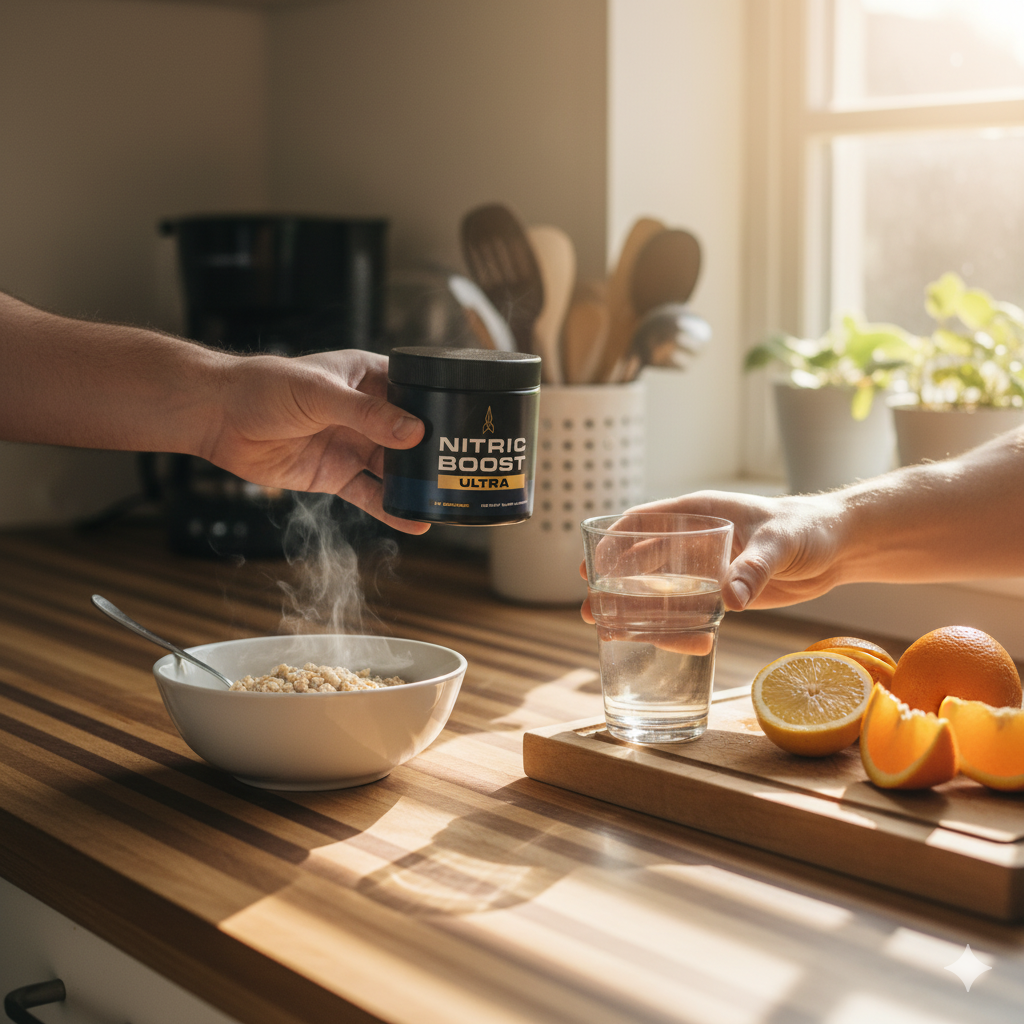
Early on, I added Nitric Boost, a nitric-oxide–support supplement that fit cleanly into my morning. I kept the bottle next to the coffee grinder so I wouldn’t forget.
By week two, I caught a full inhale without bracing first. A small moment, but it felt like my chest had more room.
How Nitric Boost fits my rhythm
I take Nitric Boost with water after breakfast. If I’m training later, I’ll time another serving closer to the workout window. What I notice when I’m consistent:
- A gentle loosening across the upper ribs on my first steps outside.
- Warmer hands in cold air—flow that actually reaches the edges.
- Stairs without that old micro-squeeze.
- A clearer head for deep work, like someone opened a window.
Put Flow On Your Side
Make each morning easier—start with the bottle that supports relaxed, ready circulation
Take Nitric Boost with breakfast. It supports your body’s nitric-oxide signaling so blood moves with less push. Keep it where you pause, use it daily, and feel the difference in stairs, first steps, and focus. This is the small, repeatable step that stacks up.
-
Hands warm up faster outdoors
-
First hill stops feeling heavy
-
Head clears for deep work
Why it made sense to try: Nitric Boost supports the body’s own nitric oxide pathway—the messenger that helps vessels relax—so blood moves with less push. That matched what my chest was asking for: less friction, more space.
Chest tightness vs. anxious tightness: my tell

I still get stress. The difference is tempo.
- Anxious tightness is loud and fast; thoughts sprint.
- Inflammation/flow tightness is quiet and heavy; breath shortens but the mind isn’t racing.
When the “quiet clamp” shows up, I check three levers:
- Sleep debt. Short nights make my chest honest fast.
- Food drift. Two crunchy, fried evenings in a row and the band returns.
- Flow routine. Walks + Nitric Boost = fewer “band” mornings.
What I watch (without getting obsessive)
I pay attention to simple signals: fingertip warmth, how quickly breath settles after a brisk walk, whether the chest feels roomy by mid-morning. Lab markers like CRP can tell part of the inflammation story, but day-to-day sensations keep me honest. I track trends, not perfection.
A small callout, in case you’re curious
If your mornings sound like mine used to—heavy, quiet pressure that shows up even on calm days—consider giving your circulation some support alongside food, light, and steady movement.
This is the exact product I kept because it fit my life and felt like a nudge in the right direction: Nitric Boost.
Back to the window, back to the breath
The heater still clicks on. The light is still soft. But the band doesn’t run my mornings anymore. It wasn’t a grand fix—just a quieter body and a clearer path for blood to move. Food with color. Walks with purpose. And one simple step—Nitric Boost—folded into the routine.
Small changes, repeated, gave me space. That’s the part I didn’t expect: the relief wasn’t dramatic. It was steady. Like the feeling of a room when someone opens a door and fresh air slides in.
Written by Elias Menden — for those who seek steadiness.
f
y
o
u
‘
r
e
s
i
t
t
i
n
g
w
i
t
h
a
k
i
n
d
o
f
c
h
e
s
t
t
i
g
h
t
n
e
s
s
t
h
a
t
d
o
e
s
n
‘
t
q
u
i
t
e
f
i
t
a
n
x
i
e
t
y
a
n
d
y
o
u
r
c
a
r
d
i
a
c
w
o
r
k
u
p
l
o
o
k
s
f
i
n
e
,
a
s
k
a
b
o
u
t
i
n
f
l
a
m
m
a
t
i
o
n
.
A
s
k
a
b
o
u
t
o
m
e
g
a
–
3
s
t
a
t
u
s
.
A
s
k
a
b
o
u
t
s
l
e
e
p
a
r
c
h
i
t
e
c
t
u
r
e
.
T
h
e
a
n
s
w
e
r
s
a
r
e
u
s
u
a
l
l
y
u
p
s
t
r
e
a
m
o
f
t
h
e
c
h
e
s
t
i
t
s
e
l
f
,
a
n
d
t
h
e
f
i
x
i
s
s
l
o
w
e
r
a
n
d
l
e
s
s
d
r
a
m
a
t
i
c
t
h
a
n
a
n
y
s
i
n
g
l
e
p
r
e
s
c
r
i
p
t
i
o
n
—
b
u
t
i
t
w
o
r
k
s
,
a
n
d
i
t
h
o
l
d
s
,
a
n
d
i
t
s
t
o
p
s
s
c
a
r
i
n
g
y
o
u
i
n
t
h
e
m
i
d
d
l
e
o
f
t
h
e
a
f
t
e
r
n
o
o
n
f
o
r
n
o
o
b
v
i
o
u
s
r
e
a
s
o
n
.
What I tell people who find themselves here
If you’re sitting with a kind of chest tightness that doesn’t quite fit anxiety and your cardiac workup looks fine, ask about inflammation. Ask about omega-3 status. Ask about sleep architecture. The answers are usually upstream of the chest itself, and the fix is slower and less dramatic than any single prescription — but it works, and it holds, and it stops scaring you in the middle of the afternoon for no obvious reason.