The question usually comes in a half-whisper, over coffee or a Zoom call:
“How do you stay this focused all day? Don’t you ever get brain fog?”
Once, the honest answer would’ve been, “All the time.”
Now, my answer starts in a very ordinary place: the way my day sounds and feels in the kitchen.
Morning light on the counter. The soft scrape of a knife on a cutting board. The smell of coffee, yes—but also eggs, greens, toast, and a quiet routine that keeps my brain online from morning to night.
Food is my foundation. And right alongside it, I lean on one anchor supplement—Synaptigen, a once-daily brain support formula that fits my “keep it simple, keep it steady” approach to focus.
This is what I actually eat in a day for laser focus and zero brain fog—and how it feels inside my body when I stick with it.
The Morning I Realized Coffee Wasn’t Enough

There was a stretch where my mornings all blurred together.
I’d roll out of bed, grab my phone, and be in my inbox within minutes. Coffee in hand. No breakfast. A tight chest. Shallow breathing. My brain trying to sprint on fumes.
By 10:30 a.m., it always hit:
- Words swimming on the screen
- That strange, cottony feeling behind my eyes
- A heavy need to lie down, even though I’d barely started the day
I kept thinking I needed “more motivation.” What I really needed was fuel.
The first change I made was boring on purpose: I stopped skipping breakfast. I told myself, “Give your brain something real before you ask it to carry you.”
The difference wasn’t dramatic like a movie scene. It was subtle:
- My hands shook less after coffee
- My mind didn’t crash as hard mid-morning
- My mood felt…rounder, less brittle
That tiny shift opened the door to everything else.
What I Eat in a Day for Laser Focus and Zero Brain Fog
Here’s how my daily rhythm looks now. It’s not perfect. It’s just steady—and that’s where mental clarity lives.
Breakfast: A Calm Start Instead of a Sugar Crash

Most mornings, the pan hits the stove before my laptop opens.
- Base: 2–3 eggs, gently scrambled
- Greens: a handful of spinach that wilts into the eggs
- Fat: slices of avocado, or a drizzle of olive oil if I want it lighter
- Optional: a slice of whole-grain toast if I know I have a long morning ahead

Put Synaptigen on Your Table
Give your brain real food—and a once-daily capsule designed to back up your focus
Synaptigen is a daily brain support formula created for focus, memory, and mental clarity. Take one capsule with breakfast and let it ride alongside your eggs, greens, and coffee. It’s a small, repeatable step that helps your mind feel prepared before the day gets loud. Add Synaptigen to your morning routine on purpose.
-
Supports clear, connected thinking through long mornings.
-
Designed to pair with real food, not replace it.
-
Simple: one capsule, once a day with breakfast.
I eat slowly enough to actually notice the warmth of the food and the way my shoulders drop. My breath gets deeper. My brain stops begging and starts working.
With breakfast, I take:
- A simple multivitamin
- Synaptigen
For me, Synaptigen is like upgrading the “wiring” in the background. Food gives me the raw materials; this supplement supports the brain side of the story—memory, focus, and that sense that my thoughts are actually connected, not scattered.
Late Morning: Quiet Stability
I try not to graze all morning. If I need something, I reach for:
- A small bowl of berries
- A handful of almonds or walnuts
Enough to keep my blood sugar from swinging. Not enough to make me sleepy.
There’s a rhythm I pay attention to now: if I feel “snacky,” I ask, “Did I under-eat at breakfast?” Most of the time, the answer is yes.
Lunch: Color and Omega-3s

Lunch is where I build a “brain bowl.”
Most days, it looks like this:
- A big plate of mixed greens
- Grilled salmon or another fatty fish
- A spoonful of sunflower or pumpkin seeds
- A light vinaigrette made with olive oil
The mix of protein, healthy fats, and fiber keeps me clear-headed through the most demanding part of my workday. My laptop fans will sometimes whir. My mind doesn’t.
On days I’m fully plant-based, I swap the salmon for:
- Lentils or chickpeas
- Hemp hearts sprinkled on top
- An algae-based omega-3 supplement to cover what I’m missing from fish
Afternoon: The Brain Fog “Danger Zone”
This is the time of day my old habits would come back to bite me. I’d hit 3 p.m. and feel like my brain had been unplugged.
Now, I plan for that window instead of fighting it.
My go-tos:
- A small handful of walnuts or almonds
- Sometimes a square or two of dark chocolate
- Green tea, warm or iced
The goal is simple: gentle lift, no crash. The nuts add slow, steady fuel. The dark chocolate satisfies my sweet tooth without pushing me over the edge.
By this point, I usually feel the long arc of Synaptigen working with everything else. Not as a jolt, but as a sense that my thoughts are still threaded together as the day wears on.
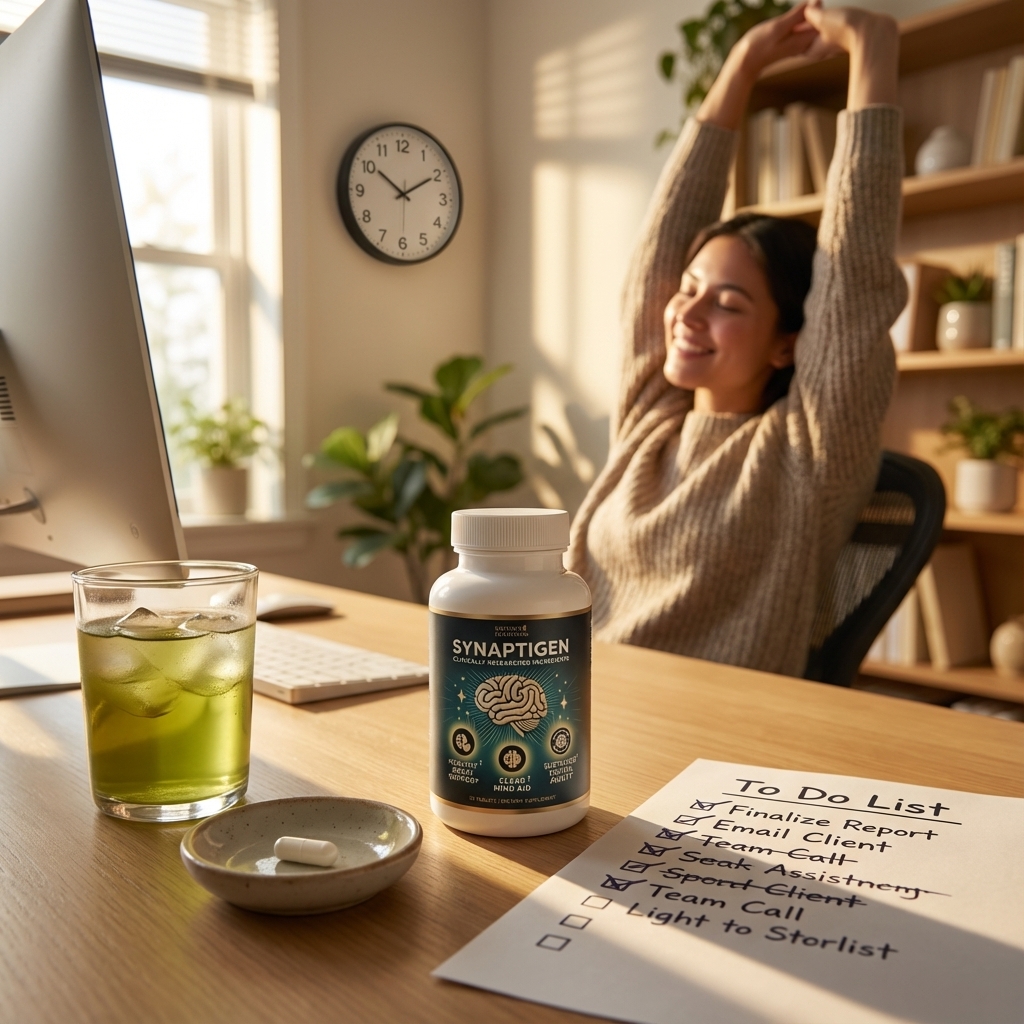
Let Synaptigen Guard Your Afternoons
When 3 p.m. hits, Synaptigen is there to support your focus instead of letting it fade
Synaptigen is built to support the part of your day when your brain usually checks out. One capsule earlier with food, and by afternoon you’ve got targeted brain support on board for focus and mental clarity. If you’re tired of watching your energy dip while your to-do list grows, make Synaptigen your daily ally.
-
Supports staying engaged through your toughest hours.
-
Helps your thoughts feel more organized, not scattered.
-
Once daily—no extra afternoon dose to remember.
Dinner: Grounding the System
Evenings are about calming the nervous system so my brain can actually reset overnight.
A typical dinner:
- A sheet pan of roasted vegetables—carrots, broccoli, Brussels sprouts, anything I have
- A lean protein like chicken, tofu, or white fish
- A side of brown rice or quinoa
The texture of roasted veggies—the crisp edges, the soft centers—does more for my mood than I expected. There’s something about ending the day with real, warm food that tells my brain, “You’re safe. You can power down soon.”
The Supplements That Quiet the Mental Noise
Food is the base of my focus. But I’m honest with myself: my daily diet, no matter how thoughtful, has gaps.
So I keep my supplement approach simple and consistent.
My Core Stack
- Multivitamin – a basic safety net
- Vitamin D & B vitamins – for mood and energy support
- Fish oil or algae oil – to back up my omega-3 intake, especially on non-fish days
- Synaptigen – my dedicated brain-support supplement
Here’s how Synaptigen fits in:

Make Synaptigen Your Brain Anchor
Out of all the bottles you could buy, choose one designed just for your brain
Synaptigen is a focused brain support formula—not a catch-all. It’s built to support memory, focus, and mental clarity in one daily step. Add it to the basics you already use and let it be the part of your stack that’s dedicated to your mind. One capsule, one clear purpose: your brain.
-
Created specifically to support brain performance.
-
Fits smoothly beside your multivitamin and omegas.
-
Easy to stay consistent: once a day, every day.
- I take it once a day, usually with breakfast or lunch
- I pair it with a meal that has at least a little fat (like avocado or olive oil)
- I treat it as part of the rhythm, not a magic trick
By week two, I noticed something subtle but real:
- I could move between tasks without that “lost in the doorway” feeling
- Names, ideas, and details surfaced faster in my mind
- The late-afternoon mental static turned down a few notches
It didn’t feel like a stimulant. It felt more like someone had cleaned off a fogged-up window.
That combination—steady meals plus Synaptigen—is what made my “what I eat in a day for laser focus and zero brain fog” routine actually sustainable, not just aspirational.
When I Break My Own Rules

I don’t eat perfectly. No one does.
Sometimes dinner happens at 9 p.m. after a late meeting. Sometimes I’m on the road and end up with a less-than-ideal fast-food meal. Sometimes I eat more dessert than I planned because the night is soft and the conversation is good.
Here’s what I do instead of spiraling:
- I don’t call it a “ruined day.”
- I do ask, “How can my next meal support clarity?”
Maybe that means:
- Adding an extra serving of veggies at the next opportunity
- Choosing whole grains over something ultra-processed
- Making sure I still take Synaptigen with a real meal, not on an empty stomach
Flexibility keeps my nervous system calmer than strict rules ever did. And a calmer nervous system is a quietly powerful focus tool.
Questions I Hear All the Time About Eating for Focus
“Do I really need to eat breakfast?”
You don’t have to eat a huge breakfast. But giving your brain something in the morning changes the shape of your day.
Even:
- A slice of whole-grain toast with peanut or almond butter
- A small bowl of oatmeal with berries
- A smoothie with some protein
can stop that mid-morning crash that feels so much like “I’m just not productive.”
“Is there a perfect meal schedule?”
There’s only the schedule your body can trust.
I aim to eat every 3–4 hours during the day. That keeps me out of the extremes—never so hungry that I can’t think, never so full that I want a nap at my desk.
If I’m not hungry at a “normal” mealtime, I listen. Forcing food rarely helps focus. Rhythm helps more than rigid rules.
“Can I just grab any supplement for brain support?”
You could—but I wouldn’t.
For my own brain, I look for:
- A clear purpose (focus, memory, calm—not “fix everything”)
- A formula that makes sense next to my diet
- A product I feel okay taking daily, not just during “crisis mode”
That’s why Synaptigen fits my world so well. It’s built specifically around brain health and mental clarity, so it doesn’t compete with my other basics—it complements them.
A Quiet Invitation to Build Your Own Brain-First Day

Here’s what surprised me most:
When I changed what I eat in a day for laser focus and zero brain fog, my life didn’t suddenly look “optimized.”
It just felt kinder.
- Mornings stopped feeling like a sprint on empty
- Afternoons felt less like a battle against my own biology
- Evenings became a time to exhale, not just recover
My routine isn’t fancy. It’s built on:
- Steady meals
- Gentle supplements
- A body I’m finally working with, not against
If you’re craving clearer thoughts and less brain fog, don’t overhaul everything at once. Start small. One breakfast. One better snack. One consistent supplement taken with a real meal.
If you want an extra layer of support for memory, focus, and mental clarity, consider weaving Synaptigen into that rhythm the way I have—quietly, daily, alongside real food and real life.
Your brain doesn’t need perfection. It needs partnership.
Written by Elias Menden — for those who seek clarity.